
Separate Parlour Branding from Verifiable Facts
The phrase can describe a casino gaming area or an online service, but it does not establish a venue’s identity or a service’s Australian licence.
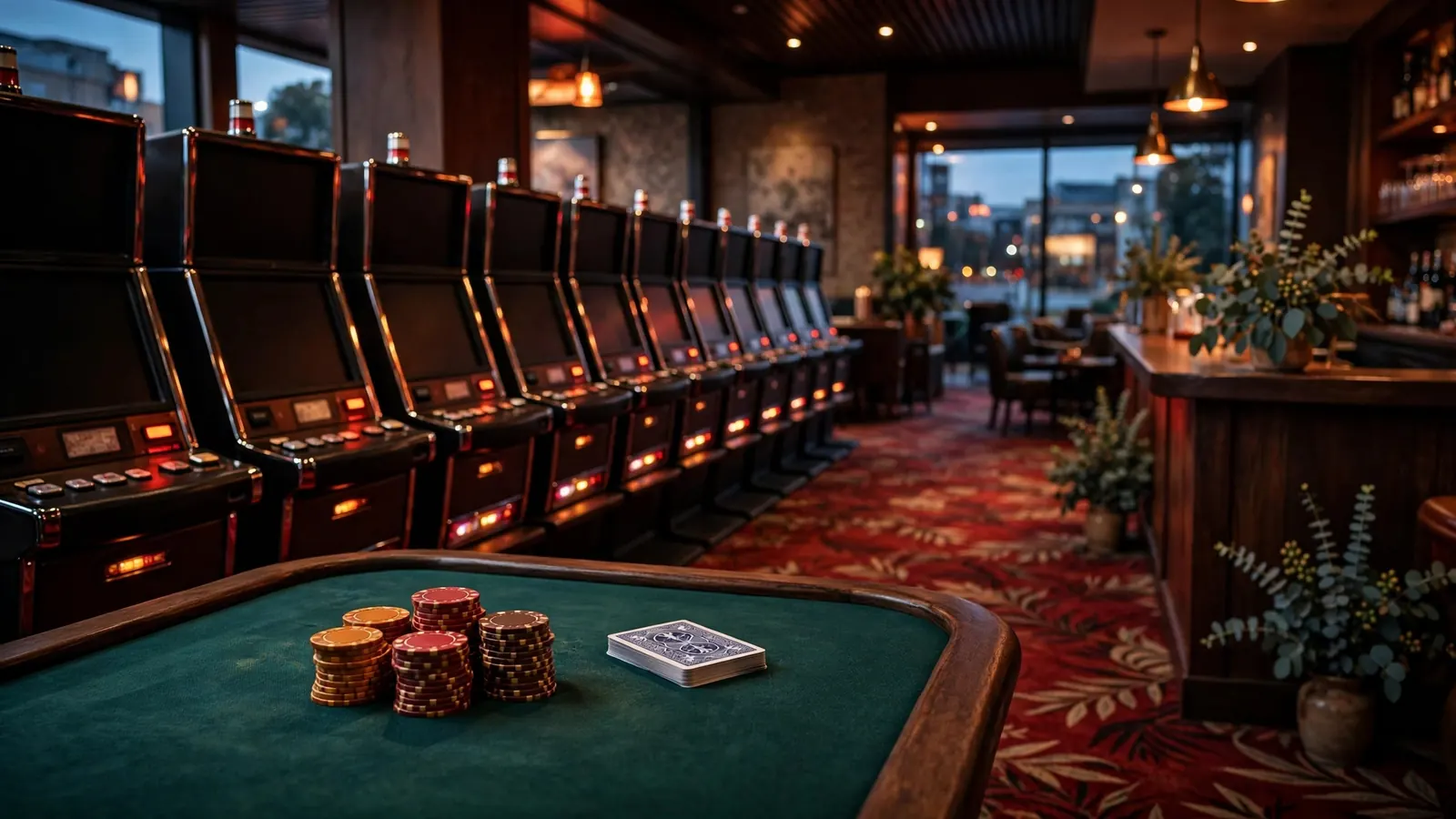
What “Pokies Parlour” Means in an Australian Casino Context
In Australia, “pokies parlour” is informal wording, not a standard label that identifies a particular casino, room or type of licence. People may use it to describe a land-based casino gaming area, or to refer broadly to a website that presents itself as an online parlour. The phrase alone does not tell you what kind of venue or service you are looking at.
That distinction matters when you are trying to understand what a name or description actually refers to. A physical casino is a property in a particular state or territory. Its operation is subject to a licence issued by that jurisdiction. An online service using similar language is not thereby connected to a local venue, nor does the word “parlour” establish that the service holds any Australian licence. Treat the wording as a description someone has chosen, not as proof of identity or regulatory status.
A venue is tied to a place and a jurisdiction
Australia’s casinos are land-based properties operating within state and territory regulatory systems. Each property’s licence comes from the jurisdiction where it operates. So, if a name is presented as a physical casino, the useful starting points are its actual location and the relevant local licensing arrangements—not whether its branding includes “pokies”, “parlour” or “casino”.
Top Operators
Choosing an online pokies venue means checking the details that matter to you, such as licensing, deposit options and payout information. Use these concise profiles as a starting point before deciding where to play.
-
Playfina Casino
- License
- Curacao eGaming (Hollycorn N.V., since 2017)
- Min. deposit
- A$20-30 (depends on the offer)
Playfina Casino is listed with a Curacao eGaming licence held by Hollycorn N.V. since 2017. The minimum deposit is A$20–30, depending on the offer.
-
7Bit Casino
- License
- Curacao, operated by Dama N.V.
7Bit Casino is operated by Dama N.V. and is listed as licensed in Curacao.
-
LuckyVibe
- License
- Curacao Gaming Control Board OGL/2023/176/0095 (Hollycorn N.V.)
LuckyVibe is listed under Curacao Gaming Control Board licence OGL/2023/176/0095, held by Hollycorn N.V.
-
Thor Casino
- License
- Curacao – Antillephone N.V. (Versus Odds B.V.)
- Min. deposit
- EUR 20
Thor Casino is listed with a Curacao licence associated with Antillephone N.V. and Versus Odds B.V. Its minimum deposit is EUR 20.
-
House of Pokies
- License
- international iGaming licence – jurisdiction not named in the source
- Payout speed
- PayID 1-24 hours
- Min. deposit
- A$30 (PayID from A$10)
House of Pokies lists an international iGaming licence, though the jurisdiction is not named in the source. PayID payouts are listed at 1–24 hours; the minimum deposit is A$30, or A$10 with PayID.
-
LevelUp Casino
- License
- Curacao eGaming OGL/2023/174/0082 (Dama N.V.)
- Min. deposit
- A$15
LevelUp Casino is listed with Curacao eGaming licence OGL/2023/174/0082, held by Dama N.V. Its minimum deposit is A$15.
-
SkyCrown
- License
- Tobique Gaming Commission
- Payout speed
- crypto ~10-15 minutes, fiat 1-5 days
- Min. deposit
- A$30
SkyCrown is listed as licensed by the Tobique Gaming Commission. Its stated payout times are around 10–15 minutes for crypto and 1–5 days for fiat; the minimum deposit is A$30.
-
WinSpirit Casino
- License
- Curacao eGaming OGL/2024/923/0383 (Antillephone N.V.)
- Min. deposit
- A$30
WinSpirit Casino is listed with Curacao eGaming licence OGL/2024/923/0383, held by Antillephone N.V. Its minimum deposit is A$30.
-
Kingmaker
- Payout speed
- crypto ~90 minutes, fiat 1-5 days
- Min. deposit
- A$30
Kingmaker lists crypto payouts at around 90 minutes and fiat payouts at 1–5 days. Its minimum deposit is A$30.
-
Lucky Dreams
- License
- Curacao
- Min. deposit
- A$20 (POLi)
Lucky Dreams is listed as licensed in Curacao. Its minimum deposit is A$20 when using POLi.
The minimum age for entering a casino is 18 nationwide. That is a basic access rule for physical casino venues; the phrase “pokies parlour” does not create a separate age category. If you are reading information about an in-person venue, keep the physical address and the jurisdiction in view. A similar name on a screen does not make an online service the same place.
A specialist review reports more than 20 full-scale casinos across all eight Australian states. That figure is an attributed snapshot, rather than a permanent definition of the market: venues and listings can change. It can help convey the breadth of the land-based sector, but it cannot identify a particular “parlour” or confirm that a venue is operating under a specific licence.
Similar wording does not mean the same thing
Online pages may borrow language associated with physical gaming venues. A site might call itself a casino parlour, use Australian-themed wording or describe its service as a local gaming room. Those choices can make the service sound familiar, but they do not establish a connection to a physical property. Nor does a familiar name, an Australian audience or a local-looking address prove that the operator is licensed in Australia.
This is why it helps to separate three things: the words used in a name, the service being offered, and the legal status of the operator. “Pokie parlour” belongs to the first category unless there is independent information tying it to a real venue. A venue name can be checked against its physical presence and local jurisdiction; branding by itself cannot do that work.
The same care applies when a site uses the name of a city, state or known entertainment district. A place reference may be descriptive or promotional. It is not confirmation that the service operates from that place, shares a licence with a local casino, or is overseen by the local venue regulator.
Read the context, not just the label
If you encounter the phrase in material about an in-person visit, look for a physical address and details that identify the relevant venue. If it appears on a website, consider it an online service’s own description until its status is independently established. Those are different contexts, even when the words are nearly identical.
Avoid relying on visual cues alone. Casino-style design, Australian slang and familiar terms can make a page seem local, but none of these features verifies who runs it or what authorisation applies. The label “parlour” is especially easy to overread because it sounds like a specific kind of place while remaining broad and informal.
For a reader seeking a pokies parlour casino in Australia, the sensible distinction is therefore between a licensed, physical casino property and an online service using comparable wording. The first has a location and a licence issued by its state or territory. The second must be assessed on its own terms; it does not inherit a venue’s identity or authorisation merely by using similar language. Keeping those categories separate helps you avoid treating a phrase as evidence.
Online Play: Check the Regulatory Record, Not the Domain
A website can load, display casino-style games or accept account traffic without being an Australian-licensed online casino. Its appearance on your screen tells you that an address is reachable at that moment; it does not establish the operator’s legal status or show that the service is authorised for people in Australia.
That distinction matters when a site presents itself as a digital version of a land-based venue or uses wording such as “play online”. A familiar name, polished page or working sign-in form is not proof of a local licence. Nor does a page become authorised simply because you can register, access an account or see games available to try.
Why the address can change
Australian internet service providers may be required to block access to websites providing prohibited gambling services or advertising them. Blocking can affect whether a particular domain resolves for you. A specialist review reports that ACMA’s blocking action has included illegal gambling services using alternate domains associated with Fair Go.
A blocked address and a newly appearing address can therefore form part of the same changing online picture. A specialist review also describes alternate addresses appearing over time as blocking affects which domains resolve through Australian providers. That does not mean every new address is connected to the same operator, or that a changed address has been approved. It means the domain alone is an unreliable guide to regulatory status.
If a link stops working and another address is offered, treat the change as a reason to check the underlying operator and service, not as evidence that access has become legitimate. The same applies if one internet connection cannot open a page but another can. Differences in reachability do not settle the legal question.

Free access is not proof of approval
Some sites use “free play” to describe games that can be tried without staking money. That label does not establish who operates the site, what rules apply to its games or whether any account information is being collected. Read the page carefully before entering personal details, and do not assume that a free mode and a real-money service have the same status or safeguards.
A site may also place free games beside account or payment prompts. The presence of a no-cost option does not turn the whole service into an approved Australian venue, and a playable demonstration does not verify the operator’s identity. Keep the assessment focused on what can be established about the service, rather than on whether a game happens to open.
What to check instead
Start with the operator’s identity and the precise service being offered. Look for information that can be checked independently, rather than relying on a logo, a claim in a banner or a statement that the site is “legal”. If the operator’s details are unclear, inconsistent across pages or difficult to verify, do not treat the website’s accessibility as reassurance.
Be cautious with links sent through messages or posts that direct you to a replacement domain. A working link is not an endorsement by a regulator. Likewise, a page that remains visible in a browser search, or that appears to accept account activity, does not demonstrate that it may lawfully provide online casino games to people in Australia.
The practical rule is simple: separate access from authorisation. Domains can change, and blocking can alter which addresses open through Australian internet providers. Neither a reachable website nor an alternate address, on its own, establishes Australian licensing.
Sign-Up and No-Deposit Bonus Claims: What You Can Verify
A sign-up bonus can sound like a simple exchange: create an account and receive a benefit. A no-deposit claim may sound even more straightforward. But a headline is not the offer itself. Before treating either claim as real, you would need to see clear, current terms that identify who is making the offer, who can receive it and what the recipient would have to do.
That distinction matters when a promotion is attached to an online casino. Under the Interactive Gambling Act 2001, operators cannot provide real-money online casino games to people physically located in Australia. A bonus label does not change the legal status of the service, and a polished page or account-registration form does not establish that an online casino is authorised to offer real-money play in Australia. Do not treat a sign-up incentive as evidence that the underlying service is lawful for Australian users.
What the claim should identify
A credible promotion description should make its source identifiable. It should name the operator responsible for the offer and provide terms that belong to that operator, rather than relying only on a banner, a search snippet or a third-party summary. If the page uses “Pokies Parlour” as a label, that wording alone does not prove which business is behind it or who is responsible for the promotion.

The terms should explain what “sign-up” means in practice. Does the claim refer to registration, identity checks, a first payment, or another step? The wording should not leave you to infer the trigger from a button or a short headline. If the stated conditions change between the promotional page and the terms, treat that discrepancy as a reason not to proceed.
For a no-deposit claim, check what the phrase excludes as well as what it promises. It may describe a benefit said to be available without an initial payment, but it does not, by itself, explain whether account creation, verification, other restrictions or later conditions apply. Those details should be set out plainly before you provide personal information or rely on the advertised value.
Read the conditions, not just the headline
Look for the complete terms, their effective date and a clear explanation of eligibility. Check whether the offer is restricted by location, account status or other stated criteria, and whether the terms explain how a person can tell if they qualify. If a promotion is described as available to new customers, the meaning of “new” should be defined rather than left ambiguous.
The terms should also say what happens after the initial benefit is credited. Read any conditions affecting use, withdrawal, expiry or cancellation, where those are stated. A headline that presents an incentive as unconditional can be misleading if the detailed terms impose requirements that materially affect its value. Do not fill gaps with assumptions based on another brand’s offer: conditions are specific to the operator and promotion.
Do
- Identify the operator responsible for the offer
- Read complete terms and their effective date
- Verify the meaning of "new customer" definitions
- Check conditions for withdrawal and expiry
Don't
- Rely on a banner or search snippet alone
- Infer the trigger for a bonus from a button
- Fill gaps with assumptions from other brands
- Provide details before establishing the operator
Check that the same offer appears consistently wherever it is described. A page that names one operator but links to a different business, or terms that do not match the headline, gives you no reliable basis for judging the claim. An inaccessible terms page, vague eligibility language or a missing operator identity should not be treated as a minor detail.
Protect your information
A promise of a bonus can be used to draw people into supplying contact, identity or payment details. Before sharing anything, establish who is collecting it and why. Read the privacy information and account conditions, and avoid sending identity documents through an unverified channel. Do not provide payment details merely because a promotion is described as “no deposit”; the phrase does not prove that no payment information will be requested.
Be wary of pressure to act immediately, requests to move the conversation to private messaging, or instructions to install software to claim an incentive. These are not proof of a particular outcome, but they make it harder to verify who is responsible and what terms apply. Keep records of the wording and conditions you were shown if you need to raise a concern.
A sign-up or no-deposit claim is not a reason to open an account. If the operator, terms or legal basis cannot be established clearly, the safer choice is to withhold your details and not rely on the promised benefit. The wording on a promotion should never substitute for a verifiable identity, transparent conditions and a lawful service.

Free Chips and Spins: No Verified Offer Details
“Free chips”, “free spins” and “free play” can sound like the same thing, but the labels do not tell you what is actually provided. They may describe different kinds of promotional credit or a way to try a game without making a cash wager. The wording alone does not establish that an offer is available, who can use it, or whether anything can be withdrawn.
Read the conditions attached to a claim before treating it as an offer. Look for a clear explanation of what the credit or spins do, which games they apply to, whether they can be converted into a withdrawable balance, and what restrictions apply to any resulting winnings. If the terms do not explain those points, you cannot safely infer them from a headline or banner.
The distinction between free play and cash value matters. A balance shown for entertainment may not be money you can withdraw. A promotional credit may also be subject to conditions that are not visible in the short wording used to attract attention. Do not assume that “free” means unrestricted, cashable, or available without any further requirement.
What to check in the wording
Before acting on a free-play claim, check whether the terms identify:
- who is eligible and whether an existing account is required;
- what the advertised chips or spins can be used for;
- whether there are conditions attached to winnings;
- whether the offer has an expiry or other time restriction;
- which rules apply if the promotion is changed or withdrawn.
These are points to confirm in the actual terms, not details that can be supplied by the phrase “free chips” or “free spins”. If the terms are missing, hard to find, or inconsistent with the promotional wording, treat the claim as unclear rather than filling in the gaps yourself. Keep a copy of the wording you relied on if you need to ask the provider to explain a discrepancy.
Be cautious with pages that use casino-style language without clearly identifying what kind of play they describe. A free-play label does not establish that a service is authorised for people in Australia, nor does it prove that an advertised benefit can be claimed. The appearance of a site or a promotional message is not a substitute for checking what the offer actually permits.
It is also sensible to pause if a claim asks you to provide personal or payment details before explaining the conditions. Do not share information just to discover whether a vague promotion is genuine. Clear terms should let you understand the nature of the free-play feature before you decide whether to engage with it.
- Identify who is eligible for the offer
- Confirm which games the credits or spins apply to
- Check for conditions attached to resulting winnings
- Verify the offer's expiry or time restrictions
- Review rules for if the promotion is withdrawn
Treat chips, spins and free play as separate claims until their terms show otherwise. That keeps promotional language from being mistaken for a cash benefit or a promise of access.
How to Read a Pokies Parlour Casino Review
A useful review separates what can be checked about a land-based venue from claims that are merely repeated online. The phrase “pokies parlour” does not, by itself, identify a particular property or establish that it holds a casino licence. Before relying on a review, check whether it names a specific venue and jurisdiction, and whether its statements are about that venue rather than an online service using similar wording.
Australia’s casino industry is regulated by state and territory authorities. Each casino property operates under a licence issued in its own jurisdiction, so a careful review should make clear which property it is discussing and where that property is located. A general statement that a brand is “licensed” is less useful if it does not identify the venue and the relevant local jurisdiction. The word “parlour” is not a substitute for those details.
Venue information is more concrete when it can be matched to an identifiable place. For instance, Lasseters Casino is located at 93 Barrett Drive, Alice Springs, in the Northern Territory. A review that gives this address makes a checkable claim about a physical venue. That does not, on its own, verify every other statement on the same page: descriptions of services, access or promotions need to be considered separately rather than treated as confirmed because an address appears.

Be cautious when a review moves from a named property to an online offer without explaining the connection. A site may use a venue-like name, images or wording, but those details do not prove that it represents the land-based casino or has the status implied by the review. Nor does a review’s confident tone turn an unsubstantiated claim into a verified one. Look for a clear distinction between information about a physical property and statements about an online account or service.
It also helps to notice how the review presents uncertainty. Does it identify what is known, or use broad claims such as “official” and “trusted” without explaining what supports them? Does it make clear which location a statement concerns? If the page offers no specific property, jurisdiction or checkable venue detail, treat its claims accordingly. A review can be useful for orienting you, but it should not be the only basis for deciding whether a venue-related assertion is reliable.
Keep the purpose of the page in view. A review may combine factual description with promotional language, and those are not the same thing. Specific venue details can be checked against the place they describe; general assurances about a brand or a service need their own evidence. Do not assume that a land-based venue’s existence confirms claims made elsewhere under a similar name. Separating those categories lets you assess a review without mistaking a polished presentation for proof.
Australian Casino Locations, Hours and Entry Basics
Australia’s land-based casino venues are spread across the country rather than concentrated in one city. A specialist review counts more than 20 full-scale casinos across all eight states, but that is a snapshot from one source, not a permanent register. The same review identifies Sydney, New South Wales, as the country’s largest gambling city, with 11 gambling facilities. Treat those figures as an indication of scale, not a guarantee that every venue currently listed is operating or open to visitors.

There are concrete examples across different regions. Lasseters Casino is at 93 Barrett Drive in Alice Springs, Northern Territory. Jupiters Gold Coast Casino & Hotel is on Broadbeach Island on the Gold Coast. Country Club Casino is listed on Country Club Avenue in Prospect, within Meander Valley, Tasmania. These details can help you orient yourself when planning a visit, but confirm the address and entry arrangements directly with the venue before travelling.
Hours and entry
All major Australian casinos operate around the clock. That describes their general operating hours; it does not mean every restaurant, service or part of a property is available at every hour. If you are going for a particular facility or event, check its opening arrangements separately.
The minimum age for casino entry is 18 nationwide. Major Australian casinos require valid photo identification for entry, so take an accepted, current ID and be ready to show it. Do not assume that an online account, a booking or being accompanied by another adult replaces the venue’s entry requirements.

A casino property may include areas beyond the gaming floor, but access rules can differ across facilities. Check the venue’s own guidance if your visit involves a restaurant, accommodation or entertainment area, particularly when travelling with someone under 18. Entry to a non-gaming part of a property should not be taken as permission for a person under 18 to enter the casino.
Planning a visit
For a land-based visit, use the venue’s official information to confirm its current address, access conditions and the particular facilities you intend to use. This is especially useful when a listing gives a suburb or island rather than a street address, or when the name of a casino is also used for a wider hotel or entertainment complex.
If you are travelling to a regional location, check the route and transport arrangements before setting out. A casino’s 24-hour operation does not establish that public transport, nearby services or every part of its complex will be available at all hours. Keep the practical checks separate: confirm where the venue is, whether your ID meets its entry requirements, and whether the specific facility you want to visit is open.
Lasseters Casino
Located at 93 Barrett Drive, Alice Springs, Northern Territory.
Jupiters Gold Coast Casino & Hotel
Situated on Broadbeach Island on the Gold Coast.
Country Club Casino
Located on Country Club Avenue in Prospect, Meander Valley, Tasmania.
Pokies Parlour Bonuses: Treat Unverified Offers with Care
A bonus claim can sound straightforward while leaving important questions unanswered. Before you rely on an advertised casino offer, look for its full written terms and check that they match the headline. A short banner or social post may omit conditions that affect who can take part and what happens after acceptance.
Start by identifying who is making the offer. The name “pokies parlour” does not, by itself, establish a particular venue, operator or licence. Make sure the promotion is clearly tied to an identifiable business and that the terms come from a channel you can independently associate with it. A familiar-looking name or page is not enough to establish who is responsible.
Then read the conditions rather than inferring them. The wording should explain who is eligible, what the benefit consists of, how it is credited, whether you need to opt in, and what restrictions apply. Check whether the offer can be withdrawn or changed, and whether the terms explain how to raise a dispute. If a key point is missing or the promotion and its conditions conflict, do not assume the interpretation most favourable to you.
Pay attention to how the benefit is described. “Bonus” can refer to different things, and a headline alone does not tell you its practical value or whether you can use it as expected. Avoid making a deposit or sharing personal details on the strength of a promise that is not supported by clear, accessible terms. Keep a copy of the wording and conditions if you need to question what was offered.

Be wary of pressure to act immediately, especially when the claim gives no clear explanation of its terms. An offer should not require you to overlook uncertainty or make a decision before you can understand the conditions. If support staff give a different explanation from the written terms, ask for clarification in writing and keep the response.
The sensible approach is to treat promotional language as a claim to assess, not as proof of a benefit. Clear terms can help you understand what is being offered, but they do not turn an unclear or unsupported promise into a reliable one. If the details remain ambiguous, step back rather than treating the headline as a commitment.
VIP Parlour Claims and What the Facts Can Support
“VIP” can sound like a defined status, but the label alone does not tell you what access or benefits a venue provides. A page or message using VIP parlour language is not, by itself, evidence of a formal programme, special entry rights or a particular casino venue. Treat those as separate claims that need clear, venue-specific confirmation.
Before relying on an offer of VIP access, identify the actual land-based venue and read its own entry information. Look for concrete details about who may enter, what identification is required and whether any stated conditions apply. Major Australian casinos require valid photo ID for entry. A VIP label does not replace that requirement, and it does not establish an exception to the nationwide minimum entry age of 18.
Be cautious when wording is vague. Claims such as “exclusive access” or “VIP treatment” have little practical meaning unless the venue explains what they involve and how eligibility is determined. Do not assume that a name used online corresponds to a licensed casino, a recognised membership scheme or a guaranteed entitlement. The wording may be promotional, informal or unrelated to a physical venue.
If the claim concerns a particular casino, confirm it through that venue’s own published information or direct contact details. Keep the distinction clear between an invitation to enquire and a confirmed right of entry. If the terms are unclear, avoid sharing personal or payment details on the strength of the VIP label alone.
VIP language can describe an impression, not a verifiable status. Your useful reference points are the identified venue’s entry rules, valid photo identification and the age requirement that applies across Australia.
Parlour Pokies and the Australian Casino Machine Context
The word “parlour” does not tell you how many gaming machines a casino has, or whether its machines are the same as those at another venue. It is a descriptive label, not a reliable guide to a particular machine collection. For a clearer picture, distinguish the familiar language people use from the figures recorded for casino venues.
Across Australia, 3,308 gaming machines are recorded as both endorsed on casino venue licences and installed in casinos. That figure gives a national snapshot of the licensed, installed machine base. It does not mean that every casino has the same number, that each machine is available at all times, or that the figure describes machines in every kind of gaming venue.
If you are trying to understand what “parlour pokies” refers to at a particular location, the national total cannot answer venue-specific questions. It does not identify individual machines, their features or availability, and it should not be read as a promise about what you will find when you visit. Those details need to be tied to the named venue and current information from that venue.
The distinction matters because a broad label can make separate places sound interchangeable. The national count is useful for understanding the scale of casino machine provision, but it is not a directory or a description of a single parlour. Keep the number in that context: it is a countrywide total, not evidence that every casino offers an identical experience.

Real-Money Online Casino Searches and Australian Restrictions
A website offering real-money online casino play to people in Australia is not made lawful by calling itself a parlour, using a familiar name or operating from overseas. Under the Interactive Gambling Act 2001, operators must not provide these services to people physically located in Australia. The restriction applies to online casino-style gambling, not just to a particular brand or website address.
The Australian Communications and Media Authority (ACMA) is the federal regulator responsible for enforcing that Act and monitoring compliance with federal interactive gambling laws. Where a website provides prohibited services or advertises them in Australia, ACMA can ask Australian internet service providers to block access. Blocking is part of enforcement, not proof that a website has been permanently removed or that another address for it is lawful.
ACMA reports that enforcement action has led to more than 1,455 illegal gambling and affiliate websites being blocked since November 2019. Its record of market withdrawals is less consistent across published figures: one account says more than 210 illegal services have withdrawn since enforcement began in 2017, while another gives a figure of over 190 for the same period. Those totals should not be presented as a single settled number.
For you, the practical distinction is between an operator’s claims and the regulator’s remit. A site’s appearance, availability or payment process does not confer permission to provide prohibited online casino services in Australia. The law targets operators; players are not subject to a fine or criminal prosecution simply for using an offshore casino. That does not make the service lawful, protected or equivalent to a locally licensed land-based venue. If you are assessing a real-money offer, rely on the legal position and ACMA’s enforcement information rather than promotional language or an address that happens to load.