
Know the legal and practical risks before you play
Australian law, payment claims, site checks and safer gambling controls each matter, but none makes an online casino lawful or risk-free.
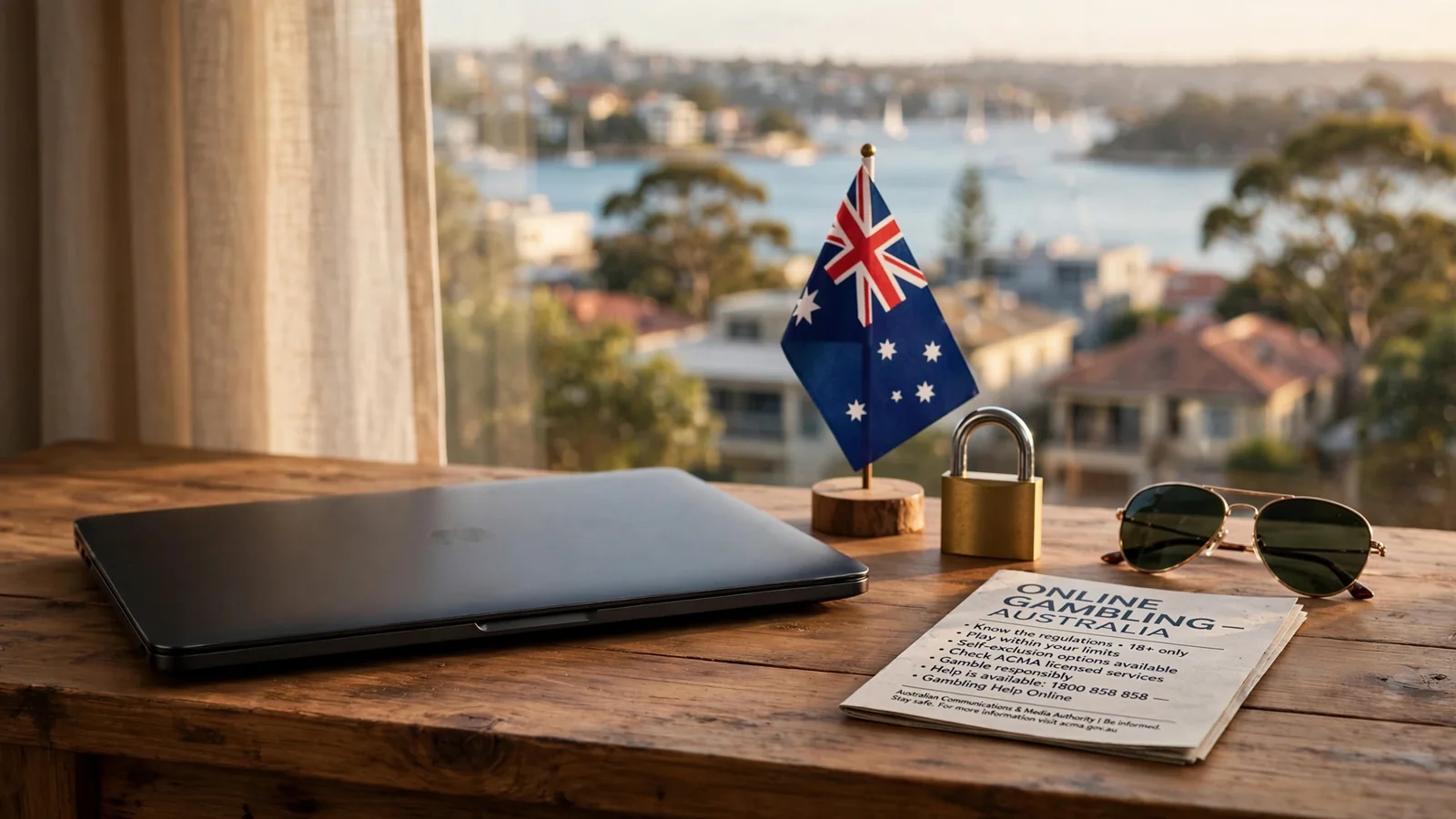
The legal position on online casino games in Australia
The word “safe” can mean several different things: protection of personal information, fair treatment, reliable payments or a service operating lawfully. For online casino games in Australia, those questions sit behind a basic legal point. The Interactive Gambling Act 2001 prohibits operators from offering online casino games to people in Australia. A polished website or a claim of an offshore licence does not change that rule or make the service licensed in Australia.
The prohibition covers casino-style games supplied online, including slots and table games. It is directed at the service being provided to people physically in Australia, rather than being a general authorisation for residents to use a service based elsewhere. In practical terms, there is no lawful domestic online casino market for real-money play under this framework. A website’s accessibility, Australian-dollar display or familiar payment option is not evidence that it is authorised under Australian law.
What the Act means for operators
The Act sets limits on what gambling services may be offered to Australians. Online casino games fall within the prohibited category, so an operator cannot make them available to customers in Australia simply by locating its business or servers offshore. An offshore licence is not the same as being licensed in Australia, and it does not override the Australian prohibition.
Top Operators
When choosing a safe online casino in Australia in 2026, you should check the available licensing and payment details rather than rely on a label alone. Use these short verdicts as a starting point for your own checks.
-
Playfina Casino
- License
- Curacao eGaming (Hollycorn N.V., since 2017)
- Min. deposit
- A$20-30 (depends on the offer)
You can note Playfina’s Curacao eGaming licence under Hollycorn N.V., held since 2017. Its minimum deposit is A$20–30, depending on the offer.
-
7Bit Casino
- License
- Curacao, operated by Dama N.V.
7Bit Casino is operated by Dama N.V. and holds a Curacao licence.
-
LuckyVibe
- License
- Curacao Gaming Control Board OGL/2023/176/0095 (Hollycorn N.V.)
LuckyVibe’s listed licence is Curacao Gaming Control Board OGL/2023/176/0095, under Hollycorn N.V.
-
Thor Casino
- License
- Curacao – Antillephone N.V. (Versus Odds B.V.)
- Min. deposit
- EUR 20
Thor Casino is licensed in Curacao through Antillephone N.V., with Versus Odds B.V. listed as the operator. Its minimum deposit is EUR 20.
-
House of Pokies
- License
- international iGaming licence – jurisdiction not named in the source
- Payout speed
- PayID 1-24 hours
- Min. deposit
- A$30 (PayID from A$10)
House of Pokies lists an international iGaming licence, though the jurisdiction is not named in the source. PayID payouts are listed at 1–24 hours; the minimum deposit is A$30, or A$10 via PayID.
-
LevelUp Casino
- License
- Curacao eGaming OGL/2023/174/0082 (Dama N.V.)
- Min. deposit
- A$15
LevelUp Casino lists Curacao eGaming licence OGL/2023/174/0082, held by Dama N.V. Its minimum deposit is A$15.
-
SkyCrown
- License
- Tobique Gaming Commission
- Payout speed
- crypto ~10-15 minutes, fiat 1-5 days
- Min. deposit
- A$30
SkyCrown is licensed by the Tobique Gaming Commission. Listed payout times are around 10–15 minutes for crypto and 1–5 days for fiat; the minimum deposit is A$30.
-
WinSpirit Casino
- License
- Curacao eGaming OGL/2024/923/0383 (Antillephone N.V.)
- Min. deposit
- A$30
WinSpirit Casino lists Curacao eGaming licence OGL/2024/923/0383, under Antillephone N.V. Its minimum deposit is A$30.
-
Kingmaker
- Payout speed
- crypto ~90 minutes, fiat 1-5 days
- Min. deposit
- A$30
Kingmaker lists crypto payouts at around 90 minutes and fiat payouts at 1–5 days. Its minimum deposit is A$30.
-
Lucky Dreams
- License
- Curacao
- Min. deposit
- A$20 (POLi)
Lucky Dreams lists a Curacao licence and a minimum deposit of A$20 via POLi.
This distinction matters when a site presents itself as “legal” because it holds approval from a regulator elsewhere. That approval may relate to the operator’s position in another jurisdiction; it does not amount to Australian authorisation. Nor does the word “licensed” on a website settle what the service may lawfully offer to someone located in Australia. The relevant question is whether the service is permitted under Australian law, not whether it displays a credential from another country.
The Australian Communications and Media Authority (ACMA) is the primary regulator for online gambling in Australia. Its role includes addressing services that breach the Interactive Gambling Act. The law’s focus on operators and services helps explain why a website’s marketing language should not be treated as a reliable guide to its status. A claim that a casino is “safe” is not a legal category, and it does not establish that the operator is allowed to provide online casino games here.
What it says about individual players
The Act does not explicitly criminalise an individual player for using an offshore casino site. That is a narrower statement than saying that offshore casino services are lawful in Australia. The prohibition on operators offering the service remains in place, even though the Act does not explicitly make the player’s act of using such a site a crime.

This difference is easy to lose in casual descriptions of the rules. Saying that a player is not explicitly criminalised does not mean that the service has Australian approval, that the operator is complying with the Act, or that playing is free of other consequences. It only describes what the Act says about individual players. It should not be read as an endorsement or as advice to access an offshore site.
If you are trying to understand whether an online casino is safe in Australia, start by separating legal status from other meanings of safety. A site may have technical features or make claims about its operations, but those details cannot make prohibited online casino services lawful. Likewise, the absence of an explicit offence for players does not turn an offshore licence into an Australian one.
The clearest legal baseline is therefore straightforward: operators are prohibited from supplying online casino games to people in Australia, while the Act does not explicitly criminalise individual players who use offshore casino sites. Keeping those two points separate helps avoid treating a lack of player criminalisation as permission, or treating a foreign licence as local authorisation.
PayID payments: what happens after you send a transfer
PayID is a way to direct a bank payment using an identifier rather than entering full account details. For a gambling deposit, the transfer still begins in your banking app: you select the payment option, enter or confirm the requested details, check the recipient shown by your bank, and authorise the transfer. The money does not move merely because you opened a payment screen; it moves after you approve the transaction.
A specialist payment review describes PayID transfers as moving through Australia’s New Payments Platform, where a payment can clear quickly, sometimes within minutes after it is released. That is a description of the payment rail, not a promise that a particular deposit will appear in an account immediately. The service may need to register or match the payment after it reaches the recipient, and processing can also depend on the payment instructions and the provider involved. Check the status shown by both your bank and the receiving service before deciding that a transfer has failed.
There can be a gap between authorising a transfer and seeing it credited. Your bank may show that the money has left your account while the other side is still processing the payment. If the deposit is not reflected, avoid sending another transfer until you have checked the transaction status and the recipient details. A second payment could create another debit rather than resolve the first one.
Deposits and withdrawals follow different paths
A deposit is money travelling from your bank or wallet to a service. A withdrawal is a request for money to travel in the opposite direction, and it can involve separate checks and processing by the service and its payment provider. A quick deposit therefore tells you little about how quickly a withdrawal will be handled. Before sending money, read the stated withdrawal method and conditions rather than assuming the route works both ways.
Payment-method timing also differs. A specialist payment review notes that PayID and some e-wallet payments may be quick once approved, whereas bank transfers and card payments can take several business days. Approval is an important distinction: a payment can be authorised by you but still await processing by the service. Bank or card processing may also involve steps outside your control, so a displayed estimate should not be treated as a guaranteed arrival time.

POLi is described in specialist payment coverage mainly as a deposit option. Do not assume that the same method will be available for withdrawals; check the withdrawal options separately before relying on it. Card withdrawals can also be slower or unavailable, depending on the processor. These differences matter when you are comparing how money enters and leaves an account, not just how quickly a deposit screen confirms payment.
What “safe” means for a PayID payment
PayID can describe the transfer method, but the label alone does not establish that the recipient is trustworthy or that a gambling service is safe. Treat a request to pay as a financial instruction: check the recipient details displayed by your bank against the instructions you were given, and do not proceed if they differ or are unclear. Keep the transaction record so you can refer to the payment if you need to query it with your bank.
A smooth transfer is not proof that the service will credit a deposit correctly, process a withdrawal, or resolve a dispute. Nor does using PayID, a bank transfer, a card or an e-wallet change the legal status of a service. Payment speed and service legitimacy are separate questions.
Promotional wording such as “no deposit” also does not explain how a later payment will be processed. Read the applicable terms before accepting an offer or making a transfer, and do not infer that a bonus removes payment conditions. If you are uncertain about the recipient or the route your money will take, pause rather than sending funds to test it.
Do
- Check recipient details displayed by your bank against instructions
- Keep the transaction record for any queries
- Read applicable terms before accepting an offer
Don't
- Proceed if recipient details are unclear or differ
- Assume a smooth transfer proves the service is trustworthy
- Send funds to test a route if you are uncertain
Real-money play does not remove the legal and consumer risks
A site can appear polished, accept deposits and let you open an account without offering meaningful protection when something goes wrong. For real-money play, the important distinction is between a service that functions and one that gives you enforceable rights. A smooth payment or a reassuring review cannot establish that your money is safe.
In Australia, the Interactive Gambling Act 2001 does not explicitly criminalise individual players for using offshore casino sites. That point is not a guarantee that playing is safe, or that you will be able to recover money from a service if a dispute arises. The legal position for an individual and the practical protection available to that person are separate questions.
The central financial risk is that an unlicensed gambling service does not provide the consumer protections associated with a service authorised in Australia. If it refuses to release winnings, closes an account or disputes the balance shown on screen, you may have few effective ways to make it put matters right. Australian laws may not assist you in recovering withheld winnings. That uncertainty matters before you deposit, not only after a disagreement starts.
A balance displayed in an account is not the same as money in your bank. It may depend on the operator’s records and its decision to process a withdrawal. If a service controls the account and the transaction, you could be left trying to resolve the issue with the same business whose decision you are challenging. A customer-support reply or an account statement may help explain what happened, but it cannot guarantee payment or create consumer protections that the service does not offer.

Claims in a casino review should be read with that distinction in mind. A review may describe a site’s games, mobile experience or payment options, but favourable descriptions do not prove that an Australian customer has a reliable remedy if funds are withheld. Nor does a foreign offshore licence amount to authorisation in Australia. Treat neither a professional-looking website nor a familiar-sounding claim as assurance about the outcome of a money dispute.
The risk is not limited to winnings. Money sent as a deposit can also be difficult to recover if an operator stops responding or refuses to return it. Before sending funds, consider whether you could bear the loss of the entire amount, rather than assuming that an account balance will be paid on request. If losing that money would affect rent, bills, debt repayments or other essentials, do not put it at risk.
Keep a clear record of what you have sent and what the account shows, including relevant messages and transaction confirmations. Records may help you describe a dispute accurately, but they do not ensure that an operator will resolve it or that Australian laws will provide a remedy. Avoid sending further money simply because a service says another payment is needed to unlock a withdrawal; pause and assess the claim rather than allowing the prospect of recovering an existing balance to drive another decision.
There is no technical shortcut that turns a risky service into a protected one. A mobile-friendly layout, a working login or quick account access says little about whether you can get your money back when there is a disagreement. Security features and payment methods have their own limits, too; they should not be confused with legal authorisation or consumer recourse.
If you are weighing up real-money casino play, separate three questions: whether the service is authorised in Australia, whether your money would have meaningful consumer protection, and whether you can afford to lose what you deposit. The answers are not interchangeable. In particular, the absence of explicit criminalisation of individual players does not make an unlicensed service safe for your finances.
How to check whether a gambling service is authorised
If a service describes itself as safe or licensed, treat that as a claim to verify, not proof. ACMA directs Australians to its website and public register for information about legal gambling products. The register is a practical starting point for checking whether a wagering service holds a valid Australian licence, but it does not turn an online casino into an authorised service.
Check what kind of service it is
First, identify what the site is offering. A service may use broad wording such as “gaming” or “betting” while also providing casino-style games. The legal status depends on the service, not on the label in its advertising or on the page where you found it.
Online casino games, including slots and table games, cannot legally be offered for real money to people in Australia. A listing or licence for a wagering service should not be read as approval for casino games on the same site. Check the specific product and operator rather than assuming that one authorisation covers every activity.
Use ACMA’s public information
Go to ACMA’s official website and locate its public register of licensed wagering services. Search using the operator’s name as it appears on the site, and compare the result with the service you are checking. Similar names can refer to different businesses, so do not rely on a logo, a search result snippet or a licence claim displayed on the site itself.
If a wagering service appears in the register, read the entry in context. It can help confirm that the named service holds an Australian licence for wagering; it is not confirmation that online casino games are permitted. If you cannot match the operator clearly, do not treat the claim as verified.
Do not confuse an offshore licence with Australian authorisation
An offshore licence may show that an operator refers to a regulator in another jurisdiction. It does not establish that the operator is licensed in Australia, or that it may offer online casino games to people here. A foreign regulator’s logo, a certificate image or wording such as “internationally licensed” is not a substitute for checking ACMA’s information.
Be cautious if a site presents a licence claim without clearly identifying the legal operator, or if its name differs across the site and the claim. Do not fill gaps with assumptions: a polished page or familiar payment option cannot settle whether a service is authorised.
What the check can tell you
The register is useful for checking Australian authorisation in the wagering market. It is not a general safety rating, a guarantee about a company’s conduct or a directory of lawful online casinos. In particular, a wagering licence should not be used to endorse casino products that Australian law prohibits operators from providing.
Checking Authorisation
-
1
Identify the service
Determine if the site is offering casino-style games, which are prohibited for real money in Australia.
-
2
Use the ACMA register
Search for the operator's name on the official ACMA public register of licensed wagering services.
-
3
Verify the licence type
Confirm if the licence is for wagering only, as this does not constitute approval for online casino games.
If your purpose is to find a real-money online casino in Australia, the key point is that there is no Australian licence that makes such a casino lawful to offer to residents. Use ACMA’s public information to understand which gambling products are legal, and do not rely on an offshore licence as evidence of local approval.
What ACMA blocking actions mean when you encounter a site
If a gambling website will not load, or access changes after working before, an ACMA blocking action may be involved. ACMA can ask internet service providers to block sites that offer prohibited interactive gambling services to Australian customers, as well as unlicensed services offered to adults in Australia. The request is directed to providers; it does not mean ACMA has assessed every page on a site or certified other sites as safe.
Blocking is one of ACMA’s enforcement tools under the Interactive Gambling Act 2001. The authority can also issue fines to operators that breach the law. A block is therefore a practical way to limit access to services that fall within the regulator’s enforcement remit, rather than a general review of a website’s quality, security or fairness.
The scale of this work is substantial. Since ACMA made its first blocking request in November 2019, it has restricted access to 1,369 illegal gambling and affiliate websites. About 1,011 of those sites have been blocked since that first request. These figures describe regulator activity over time; they are not a count of currently active services, nor a rating system for sites that remain reachable.
What a block tells you—and what it does not
A block indicates that access has been restricted following an ACMA request. It should not be read as a recommendation about another site simply because that site opens normally. Nor does a site’s continued availability establish that it is authorised to offer gambling to people in Australia. Access and legal status are different questions.
A blocked page may be unavailable through your connection because your provider has implemented an ACMA request. If you encounter that result, treat it as a meaningful warning and do not try to work around the restriction to reach the service. ACMA’s action is intended to impede access, not to prompt users to find another route.
Affiliate websites may also be included in blocking activity. A page that discusses or directs people to gambling services is not necessarily the operator itself, but ACMA’s figures include affiliate sites alongside gambling websites. That distinction helps explain why a blocked address might not look like a casino at first glance.
Blocking does not remove every risk associated with gambling websites, and it cannot make an accessible site safe by comparison. If you are trying to understand a service’s status, rely on ACMA’s public information rather than whether a page loads, appears polished or carries reassuring claims. A blocked connection is a signal to stop and take care; an unblocked connection is not proof of legitimacy.
Do not assume that repeated attempts, a different connection or other access workarounds change the service’s status. They do not turn a prohibited offer into an authorised one. ACMA’s enforcement addresses access at the network level, while the underlying concern is the service being offered to people in Australia. If a site has been blocked, the prudent response is to leave it blocked and avoid sending it personal or payment information.
Safer gambling controls and support information
A deposit limit can help you put a boundary around spending, but it is a control—not proof that a gambling service is safe or authorised. In Australia, online casino games are prohibited for operators to offer to local residents. A limit shown on a site does not change that position or provide the consumer protections of an authorised service.
A specialist review describes casino deposit limits that can be set daily, weekly or monthly. Treat this as a feature reported by that source, not as a standard available across services or evidence that a particular site is licensed in Australia. If you encounter such a control, check what it covers, when a change takes effect and whether it applies to deposits only. Read the terms before relying on it; a limit cannot prevent spending through another account or service.
Responsible-gambling obligations apply to licensed operators under the Interactive Gambling Act. That does not mean online casino operators can be licensed in Australia to offer prohibited games. A responsible-sounding label, a limit-setting tool or a link to support information cannot make an unlawful service lawful.
Information about gambling-related harm and directions to professional support services across Australia are features that reputable platforms provide. If gambling is affecting your wellbeing, finances or relationships, consider contacting a professional support service rather than relying on a site’s own tools. Support information should be clear and accessible, not hidden behind account settings or presented as a substitute for help.
If you are trying to reduce or stop gambling, a deposit control may be too limited for what you need. Look for support that can help you consider practical next steps and your broader circumstances. You do not need to wait until the situation feels severe to seek guidance.
When assessing claims about “safe” play, separate three issues: whether the service is authorised, what controls it offers, and whether independent support is available. These are not interchangeable. A site may display a limit while still offering a service that is prohibited in Australia, and a support link does not guarantee that you can recover money or resolve a dispute. Use control features only as one part of a broader response to gambling-related risk, not as assurance that playing is safe.
Casino games, legality and the limits of RTP
A game’s presentation does not change its legal status. In Australia, providing online slots or casino games such as blackjack to people in the country is prohibited. Calling a game safe, offering it for free, or displaying an RTP figure does not make an online casino game lawful to provide here.
RTP, or return to player, is a game’s stated return measure. It can help you compare the version of a game being offered, but it is not a promise about what you will receive in a session. It also does not tell you whether a service is authorised in Australia or whether playing there is safe.
To find the displayed RTP for a pokie, open its information or help screen. The details are often tucked behind an “i” symbol or a menu icon. Check the game itself rather than relying on a promotional description: the figure shown in a general review may not match the version available on a particular service.
- RTP
-
A game's stated return to player measure, which describes a game configuration rather than a guarantee of winnings or a safety seal.
That difference matters because a provider may release the same game with more than one RTP setting. The operator selects which version to run, so a familiar title can have different stated returns in different places. The game’s name alone is not enough to identify its version.
Even when you find the RTP, treat it as information about the game configuration, not a safety seal. It cannot establish that an online casino is lawful in Australia, that a particular service is safe, or that you will win. A high displayed return does not resolve those questions either.
If you are considering a free-play mode, remember that the format does not change the legal position on providing online casino games in Australia. Nor does a displayed RTP turn a game into a safe option. The figure describes a game setting; it is not evidence that the service offering it is permitted.
When checking game information, keep the questions separate: what version is displayed, what RTP is stated for that version, and whether the game may lawfully be offered to people in Australia. An answer to the first two does not answer the third. In particular, game details should not be mistaken for proof that an online casino is safe or authorised.
Mobile access, account checks and responsible use
A casino page that works smoothly on a phone is not evidence that the service is safe or appropriate to use in Australia. A quick login, a polished app or a familiar game provider cannot establish that an online casino is authorised here. Online casino games offered to people in Australia are prohibited under the Interactive Gambling Act 2001, so mobile access should not be mistaken for permission to play.

Account checks can also affect access to funds. Casinos conduct know-your-customer checks and require identity verification before withdrawals. You may be asked to provide photo identification, proof of your address and evidence that the payment method used belongs to you. The details must match the account information; discrepancies can lead to further questions or delays while a service reviews your documents.
Before sending identity documents, consider whether you understand who is collecting them and how they will be handled. A secure-looking login or an app installed on your phone does not, by itself, demonstrate that a service is trustworthy or that your personal information will be used appropriately. Avoid sharing passwords or verification codes with anyone claiming to help with your account.
Do not use a virtual private network (VPN) to get around access restrictions or make it appear that you are somewhere else. Using a VPN to access a casino may result in voided winnings, account closure and loss of your deposit. This is a warning about possible consequences, not a way to bypass restrictions: changing your apparent location does not make a prohibited service lawful in Australia.
The same caution applies whether you are signing in through a mobile browser, an app or a service that accepts cryptocurrency. The device and payment label do not settle questions of authorisation, account handling or the risk of losing money. If a login problem leads you to consider using another location, account or person’s details, pause rather than trying to work around the check.
If you have already submitted documents and are uncomfortable with how an account is being handled, keep records of communications and avoid sending further information until you understand what is being requested. A request for identity checks before a withdrawal is part of the process casinos use, but completing those checks does not guarantee that a withdrawal will be paid or that Australian consumer protections will apply.
What SSL encryption can—and cannot—tell you
When you enter payment details or personal information on a website, SSL encryption is intended to protect that data as it travels between your device and the site. It helps prevent information from being read by someone who intercepts the connection. Casinos use SSL to safeguard transactions and sensitive information, so encryption is a relevant technical check when you are considering what happens to data you submit.
A secure connection is not the same as a safe service. Encryption does not establish who operates a website, whether its claims are accurate, or whether it is authorised to offer gambling in Australia. It also cannot guarantee that the operator will handle your information responsibly once it reaches its systems, or that a payment or withdrawal will be dealt with fairly.
That distinction matters if you are trying to assess whether an online casino is safe. A protected connection addresses data transmission; it does not resolve the wider risks of using a gambling service. A site can encrypt information and still leave you without meaningful recourse if something goes wrong. The presence of SSL alone is not enough to identify a trustworthy or lawful service, and a list of sites described as safe should not be treated as proof of either.
Treat encryption as one narrow safeguard, not an endorsement. It may reduce the risk of your details being exposed while they are sent, but it cannot make an otherwise risky service safe. Consider what information you are being asked to provide and whether you are comfortable sharing it. If the service’s claims or payment arrangements raise concerns, a secure connection does not remove those concerns.
For Australians, this check should not be confused with permission to use an online casino. SSL is a technical feature, not an Australian authorisation or a guarantee of consumer protection. It can tell you something about how a website protects information in transit; it cannot tell you whether you should trust the operator with your data or money.

Wallet and AUD payment claims: check the service, not the label
A wallet logo or an option to pay in Australian dollars can make a site look familiar, but neither tells you whether the service is authorised in Australia. Currency is a setting, and a wallet is a payment method; neither is proof that an online casino may lawfully offer games to people here.
The same applies to a polished app or a reassuring discussion on a forum. Those details may describe how a service presents itself, but they do not establish who operates it, what protections apply, or whether it holds Australian authorisation. Treat payment claims as information about a transaction, not as a safety rating.
ACMA directs people to its public information and national register to check which gambling products are legal and whether a wagering service has a valid Australian licence. Use those sources to verify the service itself, rather than relying on a payment badge, a currency selector or claims made by the operator. A licence from an offshore regulator is not an Australian licence. Nor does the appearance of a service in an app store or on a forum establish that it is authorised here.
For online casino games, the distinction matters: a familiar wallet or an AUD balance does not make an offshore casino licensed in Australia. The Interactive Gambling Act prohibits operators from providing online casino games to Australian residents. Unlicensed services also lack Australian consumer protections, and Australian laws may not help you recover winnings if the operator withholds them.
If a payment page presents local currency as a reason to trust the site, pause before sharing account or payment details. Confirm what the service is authorised to offer through ACMA’s public register and guidance. If you cannot establish that it is licensed in Australia for the relevant product, the payment label does not resolve that uncertainty.
What responsible gambling tools and support services are available?
Licensed gambling operators are required to provide responsible gambling measures, including daily, weekly or monthly deposit limits. Reputable platforms also provide information about gambling-related harm and direct you to professional support services in Australia.
What are the legal consequences for Australian players using offshore casinos?
The Interactive Gambling Act 2001 does not explicitly criminalise you for using an offshore casino, but it prohibits operators from offering online casino games to people in Australia. ACMA can take action against non-compliant operators, including blocking websites and issuing fines.
What documents might be needed for verification?
You may be asked for photo ID, proof of address and proof that you own the payment method used. KYC checks commonly take place before a withdrawal.
Which banking methods are available for deposits and withdrawals?
Payment options mentioned include PayID, e-wallets, bank transfers and cards; POLi is mainly for deposits, and card withdrawals may be slow or unavailable. PayID and some e-wallet payments can be quick after approval, while bank transfers and cards can take several business days.