
Check the Route Before You Send SOL
Learn how Australian-dollar funding, wallet transfers, casino terms and SOL volatility can affect deposits, play and withdrawals.
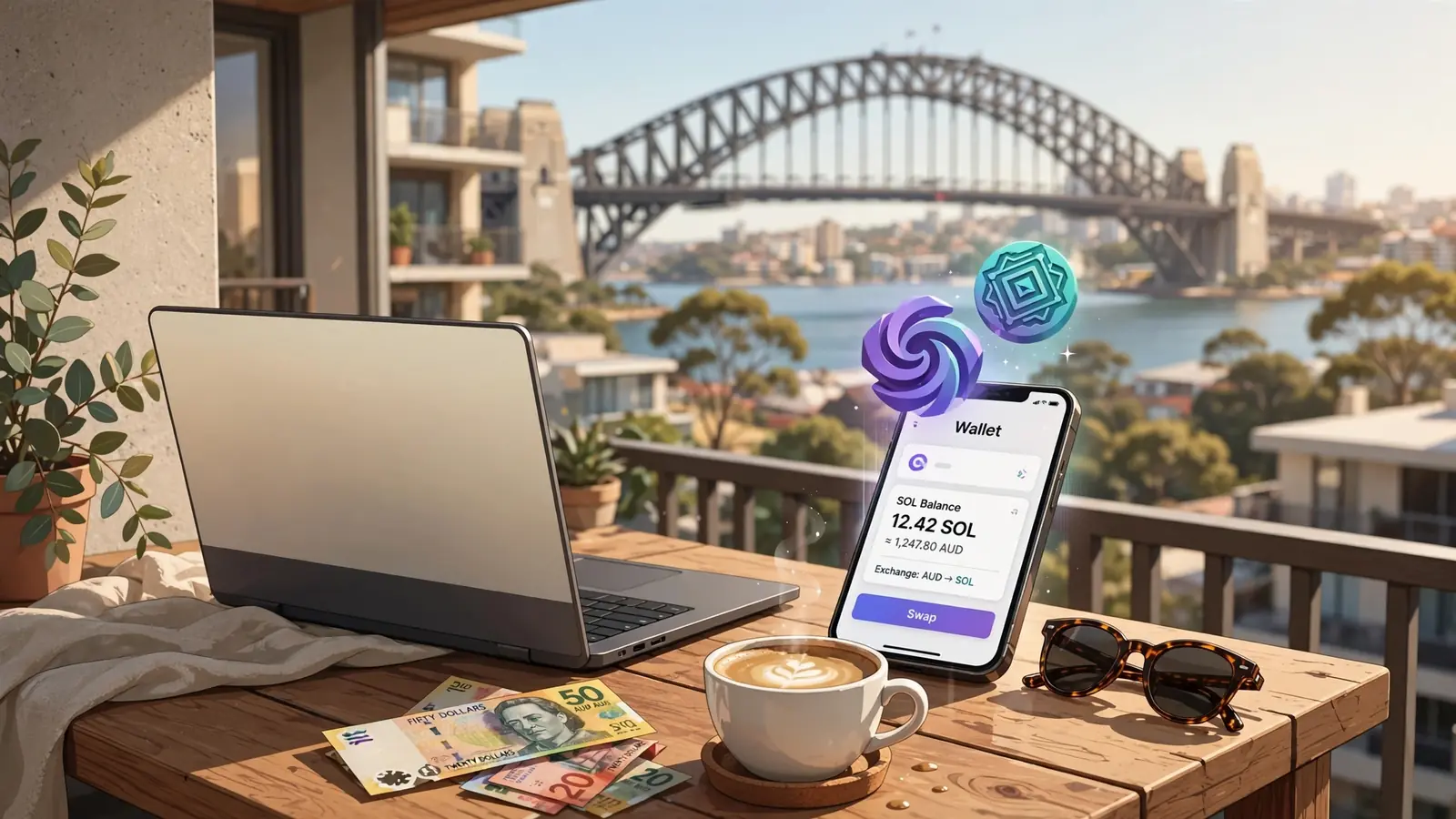
How Solana Casino Payments Work from Australia
For an Australian resident, the payment route to an offshore site that accepts SOL generally starts with Australian dollars on a crypto exchange, not with a direct bank-card payment to the casino. Most such casinos do not take AUD deposits by bank transfer or credit card. You first buy SOL through an exchange, then send it from a wallet you control to the deposit address shown by the casino.
Australian exchanges including Swyftx, CoinSpot and Coinbase AU support AUD deposits using PayID or bank transfer. You can fund an exchange account through one of those methods, complete its identity checks and use the available AUD balance to purchase SOL. The exchange is the point where ordinary currency becomes a crypto asset; the casino wallet is a separate destination for the SOL you choose to send.
From AUD to a casino balance
Before moving funds, check that the receiving casino supports SOL and that you are viewing its deposit instructions for that asset. Copy the address carefully, and make sure the sending and receiving networks match. A wallet address is not an account name that can be corrected after the fact: SOL transfers are irreversible, and a transfer sent to the wrong address can be lost permanently.
Top Operators
Choosing a Solana casino in Australia calls for checking the available licensing and payment details before deciding where to play. This list gives you a concise reference to the information provided for each operator.
-
Playfina Casino
- License
- Curacao eGaming (Hollycorn N.V., since 2017)
- Min. deposit
- A$20-30 (depends on the offer)
Playfina Casino is listed with a Curacao eGaming licence held by Hollycorn N.V., which has held it since 2017. The minimum deposit is A$20–30, depending on the offer.
-
7Bit Casino
- License
- Curacao, operated by Dama N.V.
7Bit Casino is operated by Dama N.V. and is listed as licensed in Curacao. Those are the available details for assessing its regulatory background.
-
LuckyVibe
- License
- Curacao Gaming Control Board OGL/2023/176/0095 (Hollycorn N.V.)
LuckyVibe is listed under Curacao Gaming Control Board licence OGL/2023/176/0095, held by Hollycorn N.V. Its licence details are the main distinguishing facts provided.
-
Thor Casino
- License
- Curacao – Antillephone N.V. (Versus Odds B.V.)
- Min. deposit
- EUR 20
Thor Casino is listed with a Curacao licence from Antillephone N.V., with Versus Odds B.V. identified. Its minimum deposit is EUR 20.
-
House of Pokies
- License
- international iGaming licence – jurisdiction not named in the source
- Payout speed
- PayID 1-24 hours
- Min. deposit
- A$30 (PayID from A$10)
House of Pokies lists PayID payouts of 1–24 hours and a minimum deposit of A$30, or A$10 when using PayID. The source describes its licence as international but does not name the jurisdiction.
-
LevelUp Casino
- License
- Curacao eGaming OGL/2023/174/0082 (Dama N.V.)
- Min. deposit
- A$15
LevelUp Casino is listed with Curacao eGaming licence OGL/2023/174/0082, held by Dama N.V. Its minimum deposit is A$15.
-
SkyCrown
- License
- Tobique Gaming Commission
- Payout speed
- crypto ~10-15 minutes, fiat 1-5 days
- Min. deposit
- A$30
SkyCrown is listed as licensed by the Tobique Gaming Commission. The provided payout estimates are around 10–15 minutes for crypto and 1–5 days for fiat; the minimum deposit is A$30.
-
WinSpirit Casino
- License
- Curacao eGaming OGL/2024/923/0383 (Antillephone N.V.)
- Min. deposit
- A$30
WinSpirit Casino is listed with Curacao eGaming licence OGL/2024/923/0383, held by Antillephone N.V. Its minimum deposit is A$30.
-
Kingmaker
- Payout speed
- crypto ~90 minutes, fiat 1-5 days
- Min. deposit
- A$30
Kingmaker lists estimated payouts of around 90 minutes for crypto and 1–5 days for fiat. Its minimum deposit is A$30.
-
Lucky Dreams
- License
- Curacao
- Min. deposit
- A$20 (POLi)
Lucky Dreams is listed as licensed in Curacao, with a minimum deposit of A$20 when using POLi. These are the available details provided for this operator.
The practical sequence is:
- Deposit AUD into an Australian exchange using a supported bank transfer or PayID method.
- Buy the amount of SOL you intend to use.
- Open the casino’s SOL deposit instructions and copy the specified address.
- Send SOL from the exchange or your personal wallet to that address.
- Wait for the casino balance to reflect the incoming transfer before placing any bets.
If you prefer to keep control of your crypto between the exchange and the casino, you can move SOL first to a wallet such as Phantom or Solflare, then send it onward. That creates an additional transfer to manage, so check each address and network separately. A transfer can be correctly completed on the blockchain yet still fail to appear in the casino balance if the wrong asset, network or deposit address was used.
Do not treat the displayed casino balance as AUD. It represents the crypto credited to the account, and the value of that SOL in Australian dollars can change. The distinction matters when you decide how much to send and when you later convert any funds back. Only move an amount you can afford to have unavailable or lost; a blockchain transfer cannot be reversed through your bank.
From a casino balance back to AUD
To cash out, the usual route runs in reverse: request a withdrawal in SOL, receive it in a wallet or exchange account that supports SOL, then sell the SOL for AUD and withdraw the proceeds through the exchange’s available method. Confirm that the receiving address belongs to your own wallet or exchange account and accepts the asset and network being sent. Do not send a withdrawal to an address simply because it was used for an earlier deposit; check the details again.
The exchange and the casino are separate services. A casino may show a withdrawal as processed before the funds are available to sell, while converting SOL to AUD and moving AUD to a bank account are separate steps. The exchange may require identity and transaction checks before allowing purchases, sales or withdrawals. Services that change SOL into AUD, or AUD into SOL, are subject to customer identification and anti-money-laundering requirements. Completing checks at the exchange does not necessarily mean a casino will not ask for documents of its own.
Larger withdrawals or cash-outs connected to bonuses may prompt KYC checks, including a request to verify your identity. Read the operator’s cash-out conditions before depositing, not after a balance has built up. If a withdrawal is held while documents are reviewed, there may be little you can do to speed up the casino’s decision. Keep records of your exchange transactions and wallet transfers so you can trace the route of your funds.
From AUD to SOL
-
1
Fund an exchange
Deposit AUD into an Australian exchange using a supported bank transfer or PayID method.
-
2
Purchase SOL
Buy the amount of SOL you intend to use from the exchange balance.
-
3
Copy casino address
Open the casino’s SOL deposit instructions and copy the specified wallet address.
-
4
Transfer assets
Send SOL from the exchange or your personal wallet to that address.
-
5
Verify balance
Wait for the casino balance to reflect the incoming transfer before placing any bets.
Keep the transfer route simple
Each additional account or wallet gives you another address, login and set of requirements to manage. Check the recipient address character by character, and consider whether a small test transfer is worth the extra network transaction before moving a larger amount. Do not assume a payment can be recalled if an address was copied incorrectly.
A VPN is not a payment safeguard. Using one may lead to an account being seized and funds being lost, so do not rely on it to conceal your location or bypass an operator’s controls. Offshore casinos are prohibited from providing online casino games to Australian residents under the Interactive Gambling Act 2001; using one is not legally safe simply because players are not directly penalised under that Act. Offshore operators also offer limited consumer protection, with no Australian-authority recourse if funds are withheld or a platform closes.
The key practical point is that the casino does not turn a normal AUD bank payment into a SOL balance for you. You fund an exchange, purchase SOL, send it to the casino’s stated wallet address and later reverse the route if you want AUD. Every step has its own checks and potential failure points, so verify the asset, network, address and cash-out rules before moving funds.
What to Check Before You Compare Solana Casinos
A comparison is useful only if it separates verifiable details from promotional claims. Before weighing a casino’s games, bonuses or payment options, check what the operator says about its legal status, how it explains game fairness, and what conditions apply when you try to withdraw. A polished site or a large bonus does not establish that an offshore operator is trustworthy or legally available to Australian residents.

Start with licensing disclosures
Look for a clear statement naming the operator, the jurisdiction in which it is licensed, and the authority responsible for oversight. Then check whether that information can be verified through the named authority rather than relying on a badge or a claim on the casino’s own page. If the operator does not identify who is responsible for its conduct, you have less information to assess its accountability.
A foreign licence should not be mistaken for Australian approval. Under the Interactive Gambling Act 2001, offshore operators are prohibited from providing online casino games to people in Australia. The absence of an Australian licensing framework for crypto casinos does not make an offshore platform legally safe to use. If it freezes your account or withholds winnings, you have no legal protection under Australian law through which to resolve that dispute.
Treat promises about player protection carefully. Read the terms that explain how complaints are handled and whether the operator identifies an independent dispute process. These details may help you understand the operator’s stated procedures, but they do not create Australian consumer protection or a reliable remedy if funds are withheld.
Check what RTP and fairness claims mean
RTP, or return to player, is a theoretical measure of how much a game is designed to return over extended play. It does not predict what you will win in an individual session, and a published figure is useful only if you can identify which game it applies to and where the figure comes from. Check whether the information is tied to the specific game rather than presented as a broad claim about the casino.
Provably fair tools address a different question. They may allow you to check whether a game result was generated according to the stated process. Look for an explanation of what can be verified, what information you need to perform the check, and whether the process is available for the games you intend to use. A “provably fair” label without accessible instructions is difficult to assess. These tools do not establish that the operator will honour a withdrawal or protect your account.
Read withdrawal and KYC policies before depositing
Find the withdrawal rules before you put funds at risk. Check whether the casino explains how it handles pending withdrawals, what can delay processing, and whether it reserves the right to request identity documents. Larger withdrawals or bonus cash-outs may trigger KYC checks requiring ID verification. If you would not be willing or able to provide the requested documents, consider that before depositing rather than after a win.
Also look for conditions that could affect access to your balance, including rules about account closures and bonus-related withdrawals. Policies that are hard to locate, vague about the operator’s discretion, or inconsistent across the site leave you with less certainty. An offshore casino offers limited consumer protection, and Australian authorities are not a fallback if the platform closes or refuses payment.
Do not use a VPN to get around access restrictions. An operator may treat that as a breach of its rules, with the risk that your account is seized and funds are lost. A casino’s technical accessibility is not evidence that it is permitted to serve Australian residents.

Compare the bonus as a set of conditions
Do not judge an offer by its headline amount alone. A specialist review’s method for assessing effective bonus value considers the playthrough requirement, game contribution, time limits and any maximum cash-out cap. Those terms determine whether an offer can realistically be converted into withdrawable funds. A bonus can appear generous while its conditions sharply limit its practical value.
Check which games count, how much they contribute, when the offer expires and whether winnings are capped. Then read the cash-out rules alongside the bonus terms, not as a separate detail. If the operator does not explain how these conditions work together, you cannot reliably compare the offer with another one.
Finally, treat every promotional claim as something to verify. If a site or comparison page uses affiliate links, that relationship should be disclosed clearly; promotion is not independent evidence of quality. No checklist can make offshore play safe under Australian law, but careful scrutiny can help you identify unclear terms and avoid mistaking marketing for protection.
The Legal Position for Australian Players
Owning or transferring SOL is not, by itself, prohibited in Australia. The legal issue arises when it is used to gamble through an offshore online casino. Under the Interactive Gambling Act 2001, overseas operators must not provide online casino games to people in Australia. Paying with cryptocurrency rather than Australian dollars does not change the nature of the service.
That distinction matters when considering a Solana casino that accepts Australian customers. The Act is directed at the operator providing the service, not at an individual punter using it. Australian players are not directly penalised under the Act simply for taking part. But the absence of a direct penalty for the player is not approval of the activity, nor does it make offshore play legally safe. A platform’s willingness to accept SOL does not establish that it is permitted to serve people in Australia.
The legal position can feel confusing because two things are true at once: you may legally hold SOL, while an offshore operator may still be prohibited from offering casino games to you in Australia. The payment method does not create a separate exception. Whether the balance is held in SOL or another digital asset, the relevant question is still whether an operator is providing an online casino service to someone located here.
What ACMA enforcement means
The Australian Communications and Media Authority (ACMA) enforces the Act and can block access to unlicensed offshore gambling websites. A site appearing online, or remaining accessible for a time, should not be taken as evidence that it has Australian approval. Blocking is an enforcement measure; it does not turn an offshore casino into a locally licensed service or give its customers Australian consumer protections.
Nor does the fact that players are not directly penalised settle the practical risks. If an offshore platform freezes an account or refuses to release winnings, you have no Australian legal protection against that operator through a local casino licensing system. Australian authorities may act against prohibited services, but that does not give you a straightforward local route to recover money from an offshore business. The operator may also become inaccessible, including after a site is blocked.

Avoid trying to get around a block with a VPN. A platform may treat that as a breach of its terms and seize an account or funds. It does not change the operator’s obligations under Australian law, and it can make an existing dispute harder to resolve.
Crypto does not create a licensing category
As of mid-2026, a specialist review describes Australia as having no dedicated licensing framework for crypto-gambling operators. That should not be read as a gap that permits offshore casinos to serve Australian residents. The Interactive Gambling Act’s restriction concerns the online casino service, not whether deposits are made in fiat currency or cryptocurrency.
For that reason, a claimed overseas licence, a crypto payment option or a Solana-specific label is not evidence of authorisation to offer casino games in Australia. These details may describe how a business operates elsewhere; they do not override the Australian restriction. There is no basis for treating a Solana casino as legally safe for Australian players merely because it accepts a commonly used digital asset.
If you are assessing the legal exposure, keep the distinction clear: Australian law permits buying, holding and transferring SOL, but offshore casino operators are prohibited from providing online casino games to people here. Players are not directly penalised under the Act, yet that does not remove the legal uncertainty or the lack of local recourse if an offshore operator withholds funds.
Solana Slots, Bonus Wagering and Cash-Out Terms
A bonus shown in SOL is not necessarily a balance you can withdraw. If it comes with a wagering requirement, you must place the required bets before any eligible winnings can be cashed out. The requirement may apply to the bonus alone or to the bonus plus your deposit, so check which calculation the terms use.
The difference can be substantial. A specialist review gives the example of a 5 SOL bonus with a 40x wagering requirement: you would need to make 200 SOL in bets before withdrawal. That is the total amount wagered, not the amount you need to win. Your balance can fall while you work through it, and completing the requirement does not guarantee that you will still have funds to withdraw.
The game you choose can affect how quickly wagering is counted. Slots commonly count their full stake towards the requirement, while blackjack and roulette may count only 10–20%. That means a bet of the same size can contribute very differently depending on the game. Check the contribution rules for the specific games covered by the offer; do not assume that every game helps you clear the requirement at the same rate.

Free spins need separate attention. A specialist review describes an offer where winnings from free spins are credited as bonus funds and carry a separate wagering condition, such as 50x. Read whether those winnings are withdrawable, whether they must be played through, and which games count. A free-spin prize can look like a cash balance on screen while remaining subject to restrictions.
Before accepting an offer on a site that takes SOL, look for the full cash-out terms, not just the headline bonus. Check the wagering basis, eligible games, any time limit and any maximum cash-out cap. Confirm what happens to your deposit if you decline or fail to complete the offer. Read these conditions before depositing, while you can still decide not to accept them.
KYC checks may be required for larger withdrawals or bonus cashouts, so an apparent balance is not a promise of immediate payment. SOL transfers are irreversible: sending funds to the wrong address can mean permanent loss. Using a VPN may also lead to an account being seized and funds lost. Offshore casinos are prohibited from providing online casino games to Australian residents under the Interactive Gambling Act 2001; the law targets operators, but that does not make offshore play legally safe. If an operator withholds funds or closes, you have no recourse through Australian authorities.
Treat the bonus and its cash-out conditions as one offer. If the terms are unclear, or you cannot tell what counts towards completion, do not deposit on the assumption that the displayed amount will be yours to withdraw.
NFT Claims and Casinos That Accept Solana
A casino taking SOL is not automatically an NFT casino. The first description concerns a payment option: you can send SOL to an address the platform provides and, if the casino credits the transfer, use the balance to play. An NFT claim is different. It suggests that a non-fungible token has some defined role in the platform, and that role should be described clearly rather than inferred from the presence of crypto payments.
Do
- Verify the specific role of an NFT in the platform's written terms.
- Check the operator's rules on how NFTs are obtained and what rights they grant.
- Only approve wallet connections when you understand the authorization.
Don't
- Assume a casino is an "NFT casino" just because it accepts SOL.
- Mistake a supported asset like USDC for an NFT feature.
- Rely on a profile badge to establish a right to withdraw funds.
A specialist review reports that some casinos accept USDC on Solana for deposits and play as well as SOL. That is a supported-asset distinction, not evidence of an NFT feature. USDC and SOL are tokens used for transactions; an NFT is a separate kind of blockchain asset. If a platform groups these terms together in its marketing, check what it actually says the NFT does and whether the feature is available to users in practice.
An NFT might be presented as a membership pass, a collectible, or a way to access a feature. Treat each of those as a claim to verify, not as an automatic benefit of owning a token. Look for the platform’s own written terms explaining how the token is obtained, what rights it grants, whether those rights can change, and what happens if the account is closed. A picture or badge displayed beside a profile does not by itself establish access, value, or a right to withdraw funds.
Be especially careful where a token is described as a route to rewards or preferred treatment. Read the conditions attached to those promises before transferring funds or connecting a wallet. Do not assume that a token can be sold, redeemed, or used on another platform just because it is represented as an NFT. Nor should a claimed NFT benefit make you overlook the ordinary terms governing the casino balance.
The same caution applies to wallet connections. Only approve a transaction or connection when you understand what it authorises. SOL transfers are irreversible; sending funds to the wrong address can mean permanent loss. A VPN may also lead an offshore operator to seize an account and funds under its terms, so it is not a safe way to get around access restrictions.
For Australians, an offshore operator is prohibited under the Interactive Gambling Act 2001 from providing online casino games to residents. Using such a site is not legally safe simply because players are not directly penalised under the Act. Offshore operators also offer limited consumer protection, and Australian authorities cannot provide recourse if funds are withheld or a platform closes.
If you are comparing a casino that accepts Solana with one advertising NFTs, keep the two questions separate: which assets it accepts, and what specific, enforceable function the NFT is said to provide. A payment option alone does not verify the second claim. Read cash-out terms before depositing, since larger withdrawals or bonus cashouts may trigger KYC checks requiring identity documents.
Crypto Gambling and Tax on SOL Winnings
Australian tax treatment can depend on whether you are looking at a gambling win or a change in the value of the cryptocurrency used to receive it. Those are separate questions, even when the activity takes place at a Solana casino.
For recreational gambling, winnings are generally not taxable in Australia. That does not mean every amount connected with a crypto casino falls outside tax rules. The Australian Taxation Office regards cryptocurrency as an asset for capital gains tax purposes. As a result, profits associated with gambling using SOL can have a capital gains tax consequence, even where the underlying gambling winnings would generally not be taxed as ordinary income.
Keep the distinction clear: a gambling result and the tax treatment of SOL are not automatically the same thing. If you receive or hold winnings in SOL, the asset treatment may matter independently of the general approach to recreational gambling prizes. The relevant position can depend on the circumstances, so do not assume that a win is tax-free simply because it came from gambling, or that every gambling loss can be deducted against a crypto gain.
For a practical record, keep information that lets you trace what happened: the SOL involved, the dates of transactions, and the associated values shown in your account or exchange records. These details can help you explain the difference between gambling activity and any capital gain calculation. If your records are incomplete, reconstructing that history later may be difficult.
Losses are not generally available to offset gains for an ordinary recreational player. Tax commentary for Australian players describes the exception as requiring professional-gambler status, a classification with a high threshold. Do not treat frequent play, a run of wins, or a large loss as enough by itself to establish that status. If you believe your circumstances may qualify, get advice from a tax professional familiar with Australian gambling and digital assets before making a return or claiming a deduction.
The safest working assumption is to keep gambling outcomes and SOL transactions documented separately, then seek advice where the tax treatment is unclear. A crypto casino balance does not remove the need to consider the asset rules, and a recreational gambling win does not automatically settle the tax position of the SOL connected with it.
Solana Dice Games and the Cost of a Transaction
A dice game can make the payment network’s role easier to see: the wager is one part of the experience, while moving SOL and recording a transfer are separate steps. Solana’s low transaction cost may help keep the network charge small, but it does not tell you whether an offshore casino is reliable or what rules apply to a game.
A specialist review reports that Solana transactions confirm in about 400 milliseconds, with balances updating immediately. It also reports an average transaction fee of $0.00025 USD, a near-zero network cost for an individual transfer. These figures describe the blockchain transaction, not the casino’s own terms. An operator may apply separate charges or account rules, so do not treat a near-zero network fee as proof that playing or withdrawing will be cost-free.
That distinction matters when you are assessing a dice casino using Solana. A quick confirmation can show that a transfer has reached the network; it cannot settle a dispute with the operator, guarantee that a wager is accepted, or ensure that funds are available for withdrawal. Network speed and a casino’s handling of a transaction are not the same thing.
SOL transfers are irreversible. Check the receiving address carefully before sending; a transfer to the wrong address can mean permanent loss, with no ordinary reversal process. Do not rely on a small transaction fee to justify sending funds before you understand the destination and the operator’s terms.
There is also a legal boundary that a fast payment does not change. Under the Interactive Gambling Act 2001, offshore operators are prohibited from providing online casino games to people in Australia. The law targets operators rather than directly penalising individual players, but that does not make offshore play legally safe. If an account is restricted or funds are withheld, Australian authorities do not provide the consumer recourse you would have with a locally regulated casino service.
Avoid using a VPN to get around access restrictions: an operator may seize an account or funds if it treats VPN use as a breach of its terms. Before depositing, read the cash-out conditions and check whether a larger withdrawal or bonus cashout may trigger KYC checks requiring ID verification. Network efficiency can reduce the cost and delay of transferring SOL; it cannot remove those risks or replace careful checks.
Casino Games, Bonus Rules and Effective Value
A bonus is not worth its headline amount if the rules make it difficult to convert into withdrawable funds. Start by checking which balance must be wagered, which games count and how much each game contributes. These details determine the actual play required; the bonus figure alone does not.
One specialist review describes an offer with a 35x wagering requirement applied to the bonus only. That is an example of a specific offer, not a standard you should assume applies elsewhere. If a bonus is 5 SOL, a 35x requirement on that bonus means 175 SOL in qualifying bets. The calculation does not mean you must stake that amount at once, but it does show how quickly required turnover can exceed the bonus itself.
Game contribution rates change the calculation further. Slots commonly count at 100% towards wagering, while blackjack and roulette may count at only 10–20%. If a game contributes 10%, only a tenth of your stake counts towards clearing the requirement. Choosing a table game because you prefer it can therefore extend the playthrough substantially, even if the same stake would count in full on a slot.
The headline can look generous while the conditions make the offer poor value. For illustration, a 40x requirement combined with a 4% house edge can make a bonus effectively negative in value: the volume of play needed exposes you to expected losses that may outweigh the promotional funds. This is not a prediction of what you will win or lose; it shows why turnover and game rules matter more than the advertised amount.
A useful comparison includes the playthrough amount, each game’s contribution, any time limit and any maximum cash-out cap. A cap can restrict what you may withdraw even after completing the wagering. Free spins or other promotional credits may also be subject to separate rules, so do not assume all bonus funds share one set of conditions.
Before depositing, read the cash-out terms and work through the arithmetic using the games you would actually play. If the rules do not clearly explain which bets count, how winnings are treated or what can be withdrawn, the advertised value is not enough to make an informed decision.
- Identify the total wagering requirement (e.g., 35x or 40x).
- Check the contribution rate for the specific games you intend to play.
- Verify if the requirement applies to the bonus only or bonus plus deposit.
- Confirm any maximum cash-out caps associated with the offer.
- Check for any time limits before the offer expires.
SOL as a Casino Token: Volatility and Supported Assets
SOL can serve as a payment asset at an offshore casino, but that does not make it a stable way to measure what you have won. The number of SOL in your balance and its value in Australian dollars are different things. If SOL falls in price between your deposit and withdrawal, the same token amount may be worth less when you convert it back to AUD. A winning balance can therefore lose value without any change to the number shown on the casino screen.
It helps to keep two questions separate: how much SOL is in the account, and what that SOL is worth when you need the money. If you are comparing platforms, consider whether you would be comfortable with that price exposure while funds remain there. Do not treat a displayed token balance as a promise of a particular AUD cash-out value.
Some specialist reviews report that certain Solana casinos accept USDC on Solana for deposits and play as well as SOL. Where a platform supports it, USDC gives you another asset option; it does not make the casino safer, establish that its claims are reliable, or provide Australian consumer protection. Check the exact asset and network shown by the casino before sending funds. A token with the same ticker on another network is not necessarily interchangeable.
SOL transfers cannot be reversed. If you send funds to the wrong address, they may be permanently lost, so check the destination and asset carefully before confirming a transfer. Keep in mind, too, that using an offshore casino is not legally safe simply because players are not directly penalised under the Interactive Gambling Act 2001. The Act prohibits offshore operators from providing online casino games to Australian residents, and if an operator withholds funds or closes, you have no recourse through Australian authorities.
The practical choice is not simply “SOL or USDC.” It is whether you understand the asset’s price risk, whether the casino supports the exact token and network you intend to use, and whether you can accept the possibility that the value at withdrawal differs from the value at deposit. A supported alternative asset changes how you hold and play with funds; it does not remove the risks of offshore gambling.
Solana Casino Withdrawals: Timing and What Can Delay Them
A SOL withdrawal has two separate clocks: the casino’s processing queue and the Solana network. Network confirmation can be quick, but it does not begin until the operator approves and sends the payment. A specialist review reports native SOL withdrawals taking 30–60 seconds on competent platforms; that describes the transfer stage, not a guaranteed end-to-end cash-out time.
Reported operator processing ranges from 5–15 minutes where withdrawals are automated to as long as 72 hours where staff handle them manually. Internal checks, including KYC checks, can add waiting time. Larger withdrawals or cash-outs involving bonus funds may prompt a request for identity documents. Read the withdrawal conditions before depositing, so you know what could hold up a payment.
Check whether the casino charges its own withdrawal fee as well as the network fee, and whether the displayed amount is the amount you will receive. Processing speed can also be affected by network congestion, even after the casino releases the transaction.
If a payment appears delayed, check its status with the operator and confirm that the destination address is correct. SOL transfers are irreversible: a transfer sent to the wrong address can be permanently lost. Do not send more funds to “unlock” a withdrawal without independently verifying the request.
Australian residents should also understand the broader risk: offshore operators are prohibited from providing online casino games to people in Australia under the Interactive Gambling Act 2001. Using one is not legally safe merely because players are not directly penalised, and Australian authorities cannot provide recourse if funds are withheld or the platform closes.
How do Solana casino deposits and withdrawals work?
You generally buy SOL with AUD through an Australian exchange, then transfer it to the casino’s SOL deposit address. To cash out, you request a SOL withdrawal to your own wallet or exchange, then sell it for AUD if you wish.
Is it legal to use Solana casinos in Australia?
Australian residents can buy, hold and transfer SOL, but using it at offshore online casinos is a legal grey area. The Interactive Gambling Act prohibits overseas operators from offering online casino services to Australians, while the Act targets operators rather than directly penalising individual players.
How does a Solana casino work?
You transfer SOL to the casino’s specified wallet address, and the casino credits your account after receiving the deposit. You use that balance to place bets, then request any withdrawal in SOL.
How fast are Solana casino withdrawals?
The Solana network can confirm transactions in about 400 milliseconds, but casino processing adds time: automated withdrawals may take 5–15 minutes, while manual reviews can take up to 72 hours. Check the casino’s withdrawal terms, since processing speed depends on its procedures and network congestion.
Is it legal for Australians to gamble with Solana?
Australians may legally buy, hold and transfer SOL, but gambling with it at offshore online casinos operates in a legal grey zone. The law prohibits overseas operators from offering online casino services to Australian residents, though it does not directly penalise individual players.
Are Australian Crypto Casinos Safe?
You should not assume offshore crypto casinos are safe: Australian players have no legal protection if a casino freezes an account or withholds winnings. ACMA blocks unlicensed offshore gambling websites, and a casino’s promotional claims alone do not establish that it is trustworthy.