
Understand the formats before choosing a table game
Live tables stream real dealers and equipment, while RNG games generate outcomes in software; both are online gambling services.
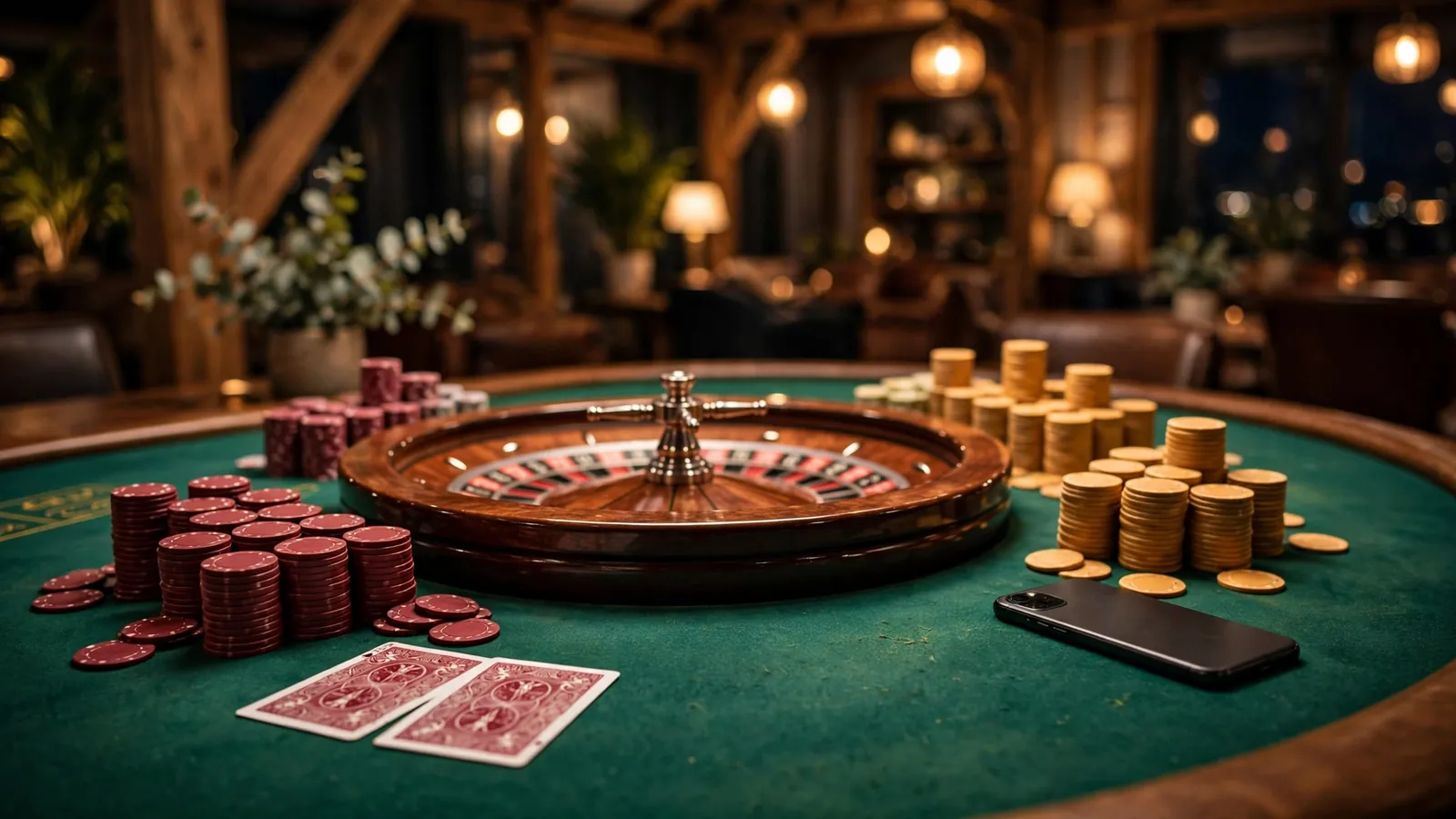
What Online Table Play Means in Australia
Online table play describes casino-style games presented through a website or app. The screen may show a dealer and physical equipment, or it may display a game generated by software. Those formats can look quite different, but both fall within the category of online casino games when offered for real money.
A live-dealer game uses a real person and real casino equipment. A camera streams the action to players, so the screen shows events taking place at a physical table rather than a scene created entirely by the game software. The streamed presentation may make the experience feel closer to watching a table in person, but it remains an online gambling service.
A computer-based table game works differently. Software uses a Random Number Generator, or RNG, to determine outcomes. For example, the RNG can select the cards dealt or determine where a roulette ball lands in the simulated game. The graphics may imitate a physical table, but the outcome is generated by the software rather than shown through a live camera feed.
Top Operators
Choosing a real-money casino for table games in Australia means checking the available operator information before you decide where to play. Use these concise verdicts as a starting point, and verify that the games and terms suit you.
-
Playfina Casino
- License
- Curacao eGaming (Hollycorn N.V., since 2017)
- Min. deposit
- A$20-30 (depends on the offer)
Playfina is listed with a Curacao eGaming licence held by Hollycorn N.V., which it has had since 2017. The stated minimum deposit is A$20–30, depending on the offer.
-
7Bit Casino
- License
- Curacao, operated by Dama N.V.
7Bit Casino is operated by Dama N.V. and holds a Curacao licence. That is the available information to consider when reviewing it.
-
LuckyVibe
- License
- Curacao Gaming Control Board OGL/2023/176/0095 (Hollycorn N.V.)
LuckyVibe is listed with Curacao Gaming Control Board licence OGL/2023/176/0095, held by Hollycorn N.V. This licence is the key stated detail to check as you assess the operator.
-
Thor Casino
- License
- Curacao – Antillephone N.V. (Versus Odds B.V.)
- Min. deposit
- EUR 20
Thor Casino is associated with a Curacao licence from Antillephone N.V., with Versus Odds B.V. named in the operator information. Its minimum deposit is EUR 20.
-
House of Pokies
- License
- international iGaming licence – jurisdiction not named in the source
- Payout speed
- PayID 1-24 hours
- Min. deposit
- A$30 (PayID from A$10)
House of Pokies has an international iGaming licence, but the jurisdiction is not named in the available information. PayID withdrawals are stated as taking 1–24 hours; the minimum deposit is A$30, or A$10 via PayID.
-
LevelUp Casino
- License
- Curacao eGaming OGL/2023/174/0082 (Dama N.V.)
- Min. deposit
- A$15
LevelUp Casino is listed with Curacao eGaming licence OGL/2023/174/0082, held by Dama N.V. Its stated minimum deposit is A$15.
-
SkyCrown
- License
- Tobique Gaming Commission
- Payout speed
- crypto ~10-15 minutes, fiat 1-5 days
- Min. deposit
- A$30
SkyCrown holds a Tobique Gaming Commission licence and has a stated minimum deposit of A$30. The listed payout speeds are around 10–15 minutes for crypto and 1–5 days for fiat.
-
WinSpirit Casino
- License
- Curacao eGaming OGL/2024/923/0383 (Antillephone N.V.)
- Min. deposit
- A$30
WinSpirit Casino is listed with Curacao eGaming licence OGL/2024/923/0383, held by Antillephone N.V. Its minimum deposit is A$30.
-
Kingmaker
- Payout speed
- crypto ~90 minutes, fiat 1-5 days
- Min. deposit
- A$30
Kingmaker lists a minimum deposit of A$30. Its stated payout speeds are around 90 minutes for crypto and 1–5 days for fiat.
-
Lucky Dreams
- License
- Curacao
- Min. deposit
- A$20 (POLi)
Lucky Dreams is listed with a Curacao licence and a minimum deposit of A$20 via POLi. Those are the stated details available for your initial assessment.
These differences explain what people mean when they refer to live and RNG table games online; they do not change the Australian legal position. The Interactive Gambling Act 2001 prohibits operators from providing real-money online casino games to people physically located in Australia. This includes table games, whether the display is a live stream or a software-generated version. Under Section 5 of the Act, locally based operators cannot offer residents real-money interactive casino games.
The restriction is directed at the operator and the service. It is not a statement that a person who encounters an overseas website has committed an offence simply by being in Australia. However, that distinction does not make an offshore casino lawful to provide here, nor does it make such a service an appropriate option to seek out. The legal framework prohibits the provision of these games to people in Australia, and enforcement measures are in place.
The Australian Communications and Media Authority (ACMA) is responsible for enforcing the rules. Its work includes blocking unlicensed services. A website appearing online, or being accessible at a particular moment, is not proof that its gambling service is permitted in Australia. Nor does a live stream, an international audience or a software-based format create an exception to the law.

This is worth keeping in mind when you see descriptions such as “real money,” “live casino,” or “table games.” They describe how a service is presented or funded; they do not establish that it can legally offer play to people in Australia. Likewise, claims about promotions or access do not alter the legal status of real-money casino games. No type of presentation turns a prohibited service into an authorised one.
Free-play descriptions are also separate from the question of real-money gambling. The important distinction in the legal context is whether an operator is providing a real-money interactive casino service to someone in Australia. A label on a page cannot, by itself, settle what a service actually offers or whether it complies with Australian law. Avoid treating promotional wording as a reliable guide to legality.
If you are trying to understand what you are looking at, first distinguish the format: a real dealer and equipment shown by live video, or an outcome produced by an RNG. Then keep that description separate from the legal question. Both formats can be online casino table games, and neither format changes the prohibition on operators providing real-money online casino games to people in Australia.
Bitcoin as a Payment Method, Not a Table-Game Type
“Bitcoin table games” combines two separate ideas. Bitcoin is a payment method; it does not describe how a table game is played or how its outcome is decided. A reference to BTC alongside casino tables is therefore about the currency or payment process associated with a service, not a distinct category of game. The table itself does not become a different kind of table because Bitcoin is mentioned.
That distinction matters if you are comparing Bitcoin-labelled table games with other casino table games. The wording alone tells you nothing about the rules, the format, or the chances attached to a particular game. It also does not establish that a service is available to you in Australia. A payment label should not be treated as proof that a real-money gambling service can lawfully be offered to people in the country.
Under Australia’s Interactive Gambling Act 2001, operators are prohibited from providing real-money online casino games to people physically located in Australia. The Australian Communications and Media Authority enforces the rules and blocks unlicensed domestic platforms. Bitcoin does not change that legal position. If a site presents table play as Bitcoin-enabled, that description is not a sign that the service is authorised for Australian residents or that access will be reliable.
The payment distinction is especially important when you encounter claims about withdrawals. A specialist review has reported that cryptocurrency withdrawals may be processed within 10–30 minutes, with the wait attributed to blockchain confirmation rather than banking processes. That is a report from one type of source, not a dependable timetable for every service or transaction. It should not be read as a promise that funds will arrive within that period, or as evidence that any particular site is accessible or lawful in Australia.

Blockchain confirmation is the point this claim concerns: a cryptocurrency transaction may need confirmation on its network before it is treated as complete. That is different from a table-game rule or outcome. It also does not, on its own, tell you how quickly a platform handles a request, whether a transaction will be accepted, or whether a withdrawal will succeed. The reported timing cannot answer those questions.
So, if you see phrases such as “Bitcoin casino table games” or “casino table games for Bitcoin,” read them as payment-related wording, not as names for special games. “Bitcoin” does not identify a game’s mechanics, and “table game” does not tell you which payment methods a service accepts. A label may describe what a service claims to support, but it cannot settle the separate questions of legality, access, or transaction timing.
This is also why a search for the best Bitcoin table games can blur two different decisions. One is about game content; the other is about a payment method. The Bitcoin wording does not establish which games are available, which are preferable, or what their odds are. Treating it as a game category can lead you to compare things that are not comparable.
For Australian readers, keep the practical point narrow: Bitcoin is a payment term, not a table-game type, and a reported blockchain-related withdrawal time is not a guarantee. Neither the payment label nor a stated processing estimate overrides Australia’s restrictions on real-money online casino services.
Why a Reliable “Best Odds” Ranking Is Not Available Here
A request for the table games with the best odds sounds as though it should have a straightforward answer. It does not: a useful ranking needs evidence that lets you compare the chances and payouts under the rules of each game. A label such as “best” cannot do that work by itself.
Random number generation is not the same thing as evidence about odds. In an online table game, software can use a Random Number Generator (RNG) to determine which cards are dealt or where a roulette ball lands. That describes how an outcome is selected. It does not, by itself, tell you how likely each possible result is, how a particular version’s rules affect those chances, or what a player could expect to receive over time.
That distinction matters when looking for a casino table-games house-edge chart. A chart is only useful if its figures relate to identifiable rules and payouts. Without that context, a percentage can appear precise while leaving out what you would need to judge the comparison. Two games with the same broad name may not be interchangeable if their rules or payout terms differ. A ranking that treats them as identical risks giving you confidence without giving you a sound basis for choice.
The same caution applies to claims about the worst odds. Naming a game as the least favourable requires a consistent comparison across the options being ranked. It is not enough to know that outcomes are generated randomly, or to assume that a familiar game must have a particular advantage for the house. Randomness describes individual outcomes; comparative odds require a separate calculation based on the game’s rules and payouts.

So, what casino table games have the best odds? There is no responsible answer that can be inferred from the RNG alone. The method that selects an outcome does not establish a ranking, and a general game category does not supply the details needed to calculate one. Treat broad claims about the “best odds” as incomplete unless they explain precisely which version and rules they cover and how the comparison was reached.
This is also why a single table of “best” and “worst” games can mislead. It may flatten meaningful differences between versions, or present a figure without showing what it applies to. If you are assessing a specific game, look for information tied to that exact version and its rules rather than relying on a category-wide ranking. If those details are not clear, the ranking is not a dependable guide to the chances involved.
For real-money play, the distinction is more than a technicality: an unsupported ranking can shape a money decision. Do not read “random” as “equal chance,” or take an RNG description as proof that one table game offers better odds than another. It tells you how the software selects an outcome, not which game is the better bet.
How Table-Game Play Works in Live and RNG Formats
The main difference between live-dealer and RNG play is how the game’s action is produced. In a live format, a real dealer uses physical casino equipment, and a video stream carries the game to the player. In an online software version, a Random Number Generator (RNG) determines the outcome, such as which cards are dealt or where a roulette ball lands.
Live-Dealer Format
A real dealer uses physical casino equipment, and the action is carried to the player via a video stream.
RNG Format
Software uses a Random Number Generator to determine the outcome, which is then displayed on the screen.
With a live stream, you watch the dealer and equipment as the game unfolds. The visual action comes from a real table rather than a software-generated representation. The stream is how the dealer’s activity is shown to players; it does not change the fact that the game is being run with physical equipment.
An RNG version presents the game through software. The program determines the relevant outcome, and the screen displays it. For a card game, that means the RNG determines the cards dealt; for roulette, it determines where the ball lands. The presentation may resemble a familiar table, but the outcome is software-determined rather than produced by a dealer and a physical wheel or deck.
These formats can look similar on screen, yet the source of the action differs. A live table shows a dealer working with real equipment through video. An RNG table shows a software interface in which the result is generated by the RNG. If you are trying to understand how a particular table is run, that distinction is more useful than judging by the graphics alone.
It also helps to separate what you see from what determines the result. In a live game, the stream shows the dealer and equipment. In an RNG game, the screen displays the outcome generated by the software. Neither format should be treated as a way to predict what will happen next: seeing a previous result does not establish the next one.

People looking to learn table-game play may find the format itself easier to understand before considering the rules of any particular game. A live stream makes the dealer and equipment visible; an RNG version makes the software-produced outcome visible. Those are differences in presentation and outcome generation, not evidence that one format is more favourable or easier to win.
Free-play wording can also cause confusion. A game displayed on a screen may be live-streamed or software-determined, but the format alone does not tell you whether play is free or involves real money. Check what the mode actually involves before engaging, and do not assume that a familiar layout means the same conditions apply.
For people physically in Australia, there is an important legal boundary: the Interactive Gambling Act 2001 prohibits operators from providing real-money online casino games to people in the country. That includes online table games. This does not alter the practical distinction between a live stream and an RNG; it is a separate point about the legal status of real-money online play.
So, when you compare how a table appears to work, look for the source of the action: a real dealer and equipment shown by live video, or an outcome determined by an RNG and displayed in software. The distinction explains the play experience without making a claim about odds or results.
Searching for Table Games Near You
A request for a nearby casino with table games can mean two different things: finding a physical venue, or looking for a way to play online. Keep those searches separate. A venue’s existence does not establish which games it offers, and an online result does not make real-money internet play lawful in Australia.
For a physical visit, focus on the venue itself and confirm its location and current table-game offering through information it publishes directly. Search results can mix casinos, other gambling venues and pages about online play; the wording “casino near me” is not proof that a place is close, open, or has the tables you want. If you have a particular game in mind, check that it is specifically listed before making travel plans. Do not assume that a general reference to casino gaming means table games are available.
Terms such as “nearest casino” depend on your location and the area covered by a result. A page about a casino in Miami or Ohio, for example, concerns a place outside Australia; it does not identify a nearby Australian venue. Likewise, a result describing a new casino or newly introduced table games needs to be read in its geographic context. A headline alone cannot tell you whether it refers to a physical venue, an online product, or a different market.
Online play is a separate issue. Under the Interactive Gambling Act 2001, operators may not provide real-money online casino games to people physically in Australia. That restriction includes table games such as blackjack, roulette and poker. The prohibition concerns the operator’s service; it does not turn an internet search result into a lawful way to play. The Australian Communications and Media Authority enforces the rules, and access to unlicensed services is subject to blocking and enforcement.
This is why “table games near me” can be misleading when the results blend physical locations with online offers. If you mean an in-person venue, use location information to assess distance and check the venue’s own current details for its games. If you mean online real-money play, do not treat an offshore site’s availability, advertising or claims as confirmation that it can legally serve people in Australia.
A careful search is about identifying what kind of place or service a result describes, not assuming that every listing matches your intended visit. Check the location, the nature of the venue and the specific table-game information before relying on a result. For online real-money casino play, the Australian legal position remains the same regardless of the wording used to find it.
What Counts as a Casino Table Game?
In online gambling, a casino table game is a game presented in one of two formats: a live-dealer stream or a software-based version whose outcomes are determined by a random number generator (RNG). The format affects how the game is produced, but both fall within the broad category of table games.
- Casino Table Game
-
An online game presented either as a live-dealer stream or a software-based version where outcomes are determined by a random number generator (RNG).
A live-dealer game uses a real person and physical casino equipment. A camera captures the action and streams it to viewers. The defining feature is that the game’s action is taking place with a dealer and real equipment, rather than being generated entirely by software. The stream is what allows the action to be seen remotely.
An online RNG version does not rely on a streamed dealer and physical equipment to determine each result. Instead, the software uses an RNG to decide outcomes. For instance, the result may determine which cards are dealt or where a roulette ball lands. Those examples illustrate how the mechanism can apply across different games; they do not make the format a separate kind of table game.
This distinction also helps clarify what “table-game software” means in this context. The term can refer to a digital version in which software determines the result, rather than to a game that is being played at a physical table and broadcast live. A live stream may involve digital tools for showing the action, but the game itself is conducted with a dealer and real equipment.
So, when you are working out what counts as a casino table game, look at the format rather than assuming that every online version works the same way. A real dealer and streamed equipment indicate a live-dealer format; software deciding the result indicates an RNG format. The label describes the kind of game presentation, not whether the game is lawful to offer in a particular place.
That distinction matters in Australia. The Interactive Gambling Act 2001 prohibits operators from providing real-money online casino games, including table games, to people physically located in Australia. This is a restriction on the service being provided; describing a game as live dealer or RNG does not change its legal status. ACMA enforces the law, including by blocking unlicensed domestic platforms.
A physical table and an online table-game product are not interchangeable simply because they share a game concept. In the online context, the useful dividing line is whether a dealer and real equipment are streamed or whether software determines the outcome. Knowing that definition can help you understand descriptions of the category without treating a format label as a sign that a real-money online service is permitted in Australia.
Table-Game Formats and Examples Supported by the Available Facts
Table games cover several kinds of play rather than one uniform format. The examples include games centred on a wheel, cards, dice and poker hands.
Roulette is one familiar wheel-based game, with European, French and American versions. The names distinguish variants, but the label alone does not tell you which rules or layout a particular offering uses. Those details matter when comparing versions, so check the game information rather than assuming that every roulette table is identical.
Wheel-Based
Games like Roulette, available in European, French, and American versions.
Card-Based
Games such as Blackjack or formats where you bet on the Banker, Player, or a tie.
Dice-Based
Games where players make a wager on an outcome associated with the roll of a pair of dice.
Poker
Contests focused on forming the strongest possible hand to prevail against other players.
Blackjack is a card game in which you play against a dealer. The aim is to finish with a hand value nearer to 21 than the dealer’s. Another card-based format lets you wager on the result for your own hand, the Banker’s hand or a tie. These are distinct ways a table game can frame a card contest; the wording of the options should be clear before you take part.
A dice-based table game centres on a pair of dice: players make a wager on an outcome associated with the roll. Read the table’s own explanation before drawing conclusions from a short label.
Poker is also part of the broader category. Its central contest is about forming the strongest possible hand. The precise rules can depend on the poker format, so the general name is not enough to establish how a particular table operates.
These examples may be presented as live-dealer tables or as software-based versions, but a game name by itself does not tell you which format is being offered. In Australia, the Interactive Gambling Act 2001 prohibits operators from providing real-money online casino games to people located in the country. Treat descriptions of game types as information, not as an invitation or assurance that online access is lawful.
If you are simply trying to understand a menu of table-game labels, start by identifying the basic type—wheel, cards, dice or poker—and then read the rules shown for that particular game. Avoid treating a short category name as a substitute for those rules.
Card Games: Blackjack and Betting on a Hand
Card table games can ask you to focus on your own hand or choose which hand will prevail. Blackjack follows the first approach: you play against the dealer, aiming to finish with a hand value closer to 21 than the dealer’s. The goal is not simply to collect cards; it is to compare the value of your hand with the dealer’s.
That gives blackjack a direct point of focus. Your attention stays on your hand and the dealer’s, with the target of getting nearer to 21. It is a distinct structure from a card game where the wager is placed on one of several possible outcomes rather than on your own hand alone.
In another card-table format, you can bet on your hand, the Banker’s hand, or a tie. The choice is about which of those outcomes you expect to occur. A bet on your hand backs that hand; a Banker bet backs the Banker’s; a tie bet selects an equal result. The options are easy to distinguish, but they are not the same as blackjack’s contest against the dealer.
This difference matters when you are working out what a table asks you to do. In blackjack, the stated aim is to make your hand value closer to 21 than the dealer’s. In the other format, the decision described here is which hand or tie to back. The two games use cards, but the focus of the player’s decision is not identical.
Do
- Distinguish between playing against a dealer to reach 21
- Understand which outcome a specific bet covers
Don't
- Assume every card game uses the same objective
- Confuse a hand-versus-dealer contest with a wager on a tie
Before taking part, make sure you understand what each betting option refers to and which outcome your selection covers. A familiar card-table setting does not mean that every game uses the same objective or choice. Keeping the distinction clear can help you follow the action without confusing a personal hand-versus-dealer contest with a wager on one of several hands or a tie.
Roulette Variants and Their Number Layouts
The main roulette variants are European, French and American. Their number layouts are easiest to compare by counting the green zero pockets: European and French roulette each have a green 0, while American roulette has both a green 0 and a green 00.
European and French layouts each contain 36 numbers alongside the single green zero. The American layout also has numbered pockets, but its additional green double-zero pocket makes the visible distinction clear. When you are checking which version a table uses, look for that second green pocket rather than relying on the variant’s name alone.
| Variant | Number layout |
|---|---|
| European | 36 numbers and a green 0 |
| French | 36 numbers and a green 0 |
| American | A green 0 and a green 00 |
This is a narrow but useful part of roulette rules: the number of green zero pockets differs between the European and French layouts on one side and the American layout on the other. The green pockets are distinct from the numbered spaces, so it is worth checking the layout itself before assuming two tables are alike.
European and French roulette share the stated count of numbered spaces and a single zero. That does not make their names interchangeable; it identifies only the number layout described here. Likewise, the extra 00 is the defining layout difference to notice when comparing American roulette with those two versions. Other details should not be inferred from the labels or from the zero count.
If you are reading a table description, match its variant name to the layout shown. A listed American table should display both 0 and 00; a European or French table should show one green 0 alongside 36 numbers. This simple check helps you understand which roulette layout is being presented without treating every casino table game as if it followed the same rules.
Poker at the Table: The Aim of the Game
Poker centres on a contest to build the best possible hand. Players compete with one another, and the hand is the focus of that contest. This shared aim is what makes poker recognisable across table-game settings, even when the particular version or way of playing differs.
The phrase “best possible hand” describes the goal, not a guarantee of success. A player may be trying to form a stronger hand than the others, but the outcome is not assured. The essential point is the competition: each player seeks to produce a hand that can prevail against the others.
That makes poker different in emphasis from a game framed around reaching a target value or betting on a particular outcome. In poker, the hand itself is central. The broad objective can be understood without assuming that every poker table follows identical rules or uses the same format.
In Australia, this distinction is for understanding the game, not an invitation to take part in real-money online poker. Under the Interactive Gambling Act 2001, operators are prohibited from providing real-money online poker to people physically located in Australia. A description of poker’s aim does not change that legal position.
If you encounter the term “casino poker,” read it as poker presented in a casino-style table setting; the defining aim remains the contest to build the strongest possible hand. Avoid treating the label alone as evidence that a real-money online service is lawful in Australia.
Can you play table games online for real money?
No, operators are prohibited from offering real-money online casino table games to people in Australia, whether the games use a live dealer or software.
Are online casinos legal in Australia?
No. The Interactive Gambling Act 2001 prohibits operators from providing real-money online casino games to people in Australia, and ACMA enforces the rules.
Can you legally gamble online in Australia?
Not at real-money online casinos: operators are prohibited from providing those services to people in Australia. This restriction concerns the service operators provide.